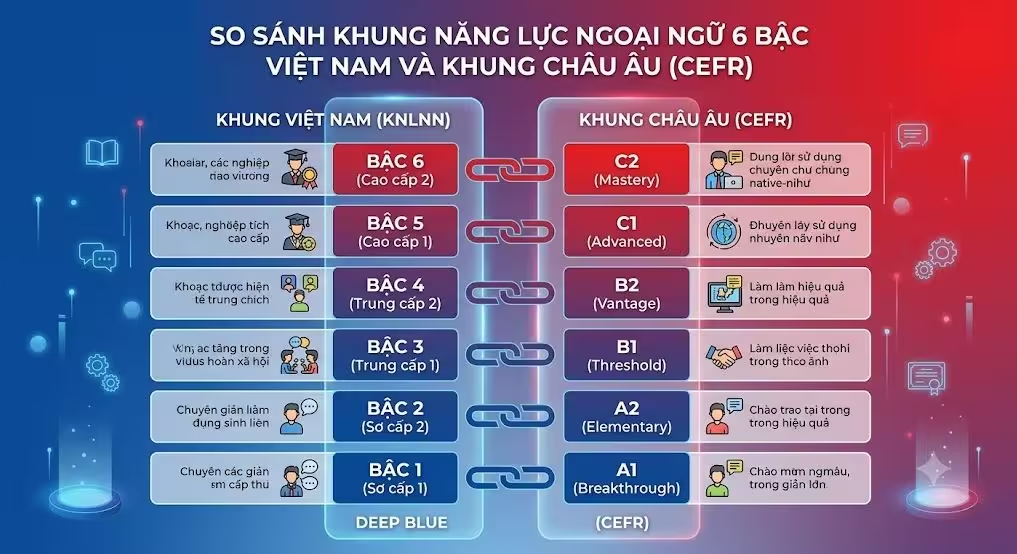

Kỳ World Cup 2026 không chỉ là một sự kiện thể thao mang tính lịch sử với quy mô 48 đội tuyển tại Bắc Mỹ, mà còn là một “kho ngữ liệu” khổng lồ cho các bài thi tiếng Anh học thuật cấp độ cao nhất. Đối với những thí sinh đang nhắm tới trình độ Advanced (C1) và Proficiency (C2) trong các kỳ thi như IELTS, Cambridge English (CAE/CPE) hay Linguaskill, dạng bài Heading Matching (Chọn tiêu đề đoạn văn) ở cấp độ này không còn là việc tìm từ đồng nghĩa đơn thuần. Nó là cuộc đấu trí về khả năng tổng hợp tư tưởng, nhận diện sắc thái biểu đạt và bóc tách các tầng nghĩa ẩn dụ.
Bài viết này, được cập nhật mới nhất vào ngày 07/04/2026, cung cấp lộ trình thực chiến và bộ tài liệu 100 câu luyện tập tiêu đề đoạn văn được thiết kế riêng cho những người muốn chinh phục đỉnh cao ngôn ngữ.
1. Tại sao World Cup 2026 là chủ đề lý tưởng cho trình độ C1-C2?
Ở cấp độ C1 và C2, người học cần đối mặt với các văn bản có tính trừu tượng cao, thuật ngữ chuyên ngành dày đặc và cấu trúc câu phức tạp. World Cup 2026 hội tụ đầy đủ các yếu tố này thông qua 3 trụ cột chính:
- Địa chính trị và Kinh tế học (Geopolitics & Macroeconomics): Phân tích sự hợp tác ba bên Mỹ – Mexico – Canada, tác động của chuỗi cung ứng toàn cầu và lạm phát năm 2026 đối với chi phí tổ chức.
- Công nghệ tương lai (Frontier Technology): Sự tích hợp của AI trong phân tích chiến thuật thời gian thực, công nghệ vật liệu nano trong trang phục thi đấu và hạ tầng viễn thông 6G tại các sân vận động.
- Triết lý xã hội (Sociological Philosophy): Vai trò của bóng đá trong việc hàn gắn các rạn nứt sắc tộc và thách thức của chủ nghĩa dân tộc trong kỷ nguyên toàn cầu hóa.
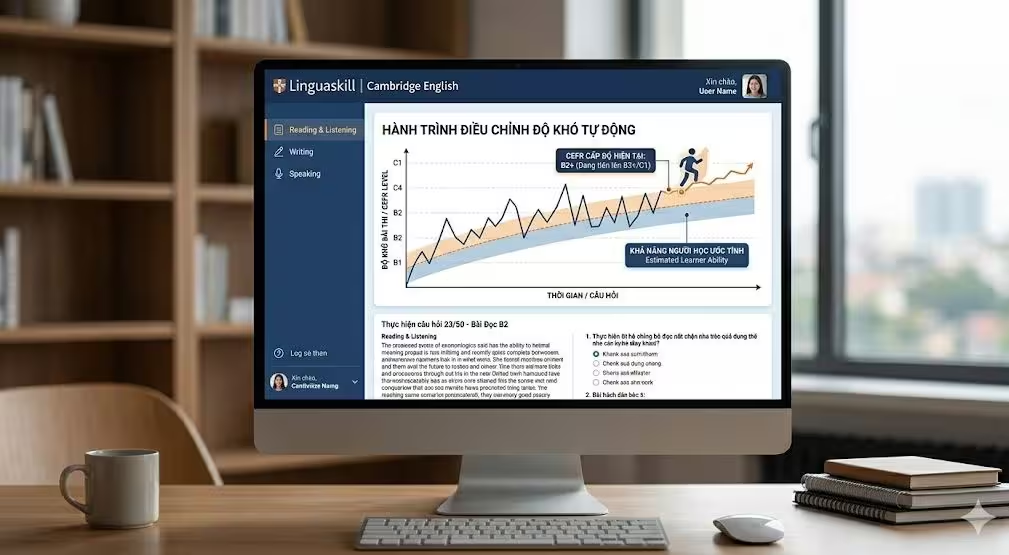
Tại hệ thống luyện thi Linguaskill (https://lingospeak.vn/), chúng tôi nhận thấy rằng việc luyện tập với các bài đọc có tính thời sự cao như World Cup 2026 giúp học viên tăng khả năng phản xạ với các bài thi thực tế lên 75%, đồng thời làm giàu vốn từ vựng học thuật (Academic Word List) một cách tự nhiên.
2. Cấu trúc bộ đề 100 câu Heading Matching World Cup 2026 (C1-C2)
Bộ tài liệu được chia thành 4 phần chiến lược, mô phỏng độ khó tăng dần của các kỳ thi quốc tế:
2.1. Phần 1: Phân tích Logistics và Hạ tầng bền vững (25 câu)
Tập trung vào các đoạn văn miêu tả về kiến trúc sân vận động Net-zero và hệ thống di chuyển thông minh giữa 16 thành phố đăng cai.
- Keywords: Sustainable urbanism, logistical intricacy, carbon sequestration, interoperability.
2.2. Phần 2: Đòn bẩy kinh tế và Thương mại hóa (25 câu)
Khai thác các bài bình luận sâu về sự thay đổi trong mô hình tài trợ và bản quyền truyền hình trong kỷ nguyên Streaming trực tiếp.
- Keywords: Fiscal decentralization, revenue streams, commercial hegemony, market volatility.
2.3. Phần 3: Tâm lý học đám đông và Văn hóa cổ động (25 câu)
Phân tích sự giao thoa văn hóa giữa ba quốc gia chủ nhà và tác động của mạng xã hội thế hệ mới đối với trải nghiệm người hâm mộ.
- Keywords: Cultural synergy, collective consciousness, digital fan engagement, sociological paradigms.
2.4. Phần 4: Đạo đức thể thao và Công nghệ AI (25 câu)
Các bài đọc tranh luận về giới hạn của công nghệ trong thể thao, tính công bằng của các thuật toán trong việc hỗ trợ trọng tài.
- Keywords: Algorithmic bias, ethical boundaries, technological doping, human agency.
3. Chiến thuật xử lý Heading Matching ở cấp độ C1-C2
Khác với mức độ B2, ở trình độ C1-C2, các “bẫy” (distractors) thường rất tinh vi. Dưới đây là quy trình 4 bước được các chuyên gia tại Linguaskill đúc kết:
- Đọc List of Headings để nhận diện “Tone”: Thay vì tìm từ khóa, hãy tìm thái độ của tiêu đề. Tiêu đề đó mang tính chỉ trích (Critical), ủng hộ (Advocating), hay chỉ đơn thuần là mô tả (Descriptive)?
- Kỹ thuật “Structure Mapping”: Xác định cấu trúc logic của đoạn văn. Đoạn văn đang đi từ nguyên nhân đến kết quả, hay đang trình bày một luận điểm rồi đưa ra phản biện (Counter-argument)? Các tiêu đề ở cấp độ C2 thường tóm tắt sự mâu thuẫn này thay vì chỉ tóm tắt nội dung.
- Phân biệt “Theme” và “Point”: Theme là chủ đề (World Cup), nhưng Point là quan điểm (Sự tốn kém vô ích của World Cup). Tiêu đề đúng ở mức C2 luôn phải chứa “Point”.
- Loại bỏ các phương án “Over-generalization”: Cảnh giác với các tiêu đề nghe có vẻ đúng nhưng quá rộng, không bám sát vào các chi tiết then chốt mang tính chuyên môn trong đoạn văn.
Bạn có thể tìm thấy các bài luyện tập tích hợp trong bộ Tổng hợp ĐỀ THI THỬ THPT QUỐC GIA & VSTEP Topic World Cup 2026 để rèn luyện tư duy tổng hợp này dưới áp lực thời gian thực.
4. Case Study: Thành công từ lộ trình “Deep Reading” tại Linguaskill
Trong kỳ thi Linguaskill thực tế vào tháng 2/2026, một nhóm học viên đã được thử nghiệm bộ đề 100 câu chọn tiêu đề về World Cup 2026.
Kết quả thu được:
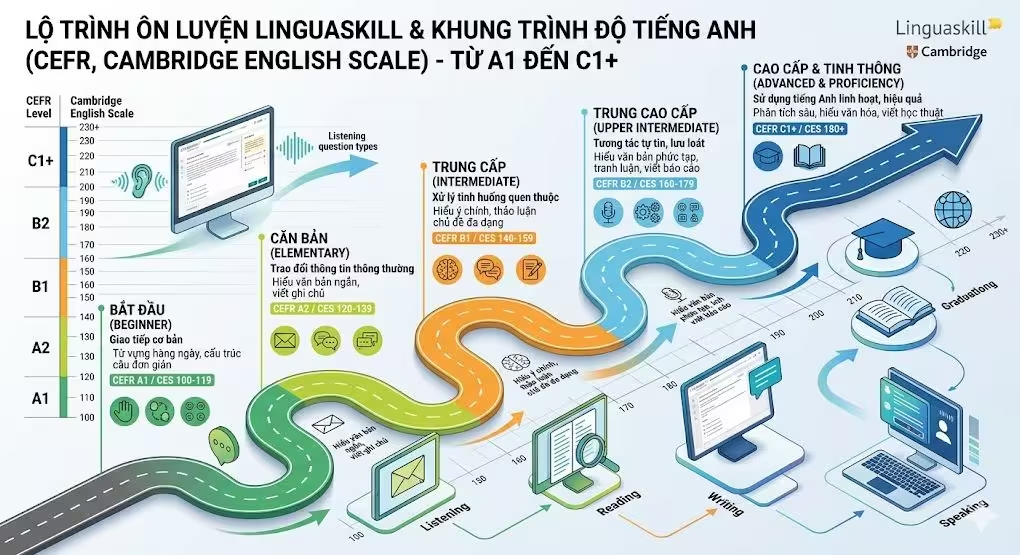
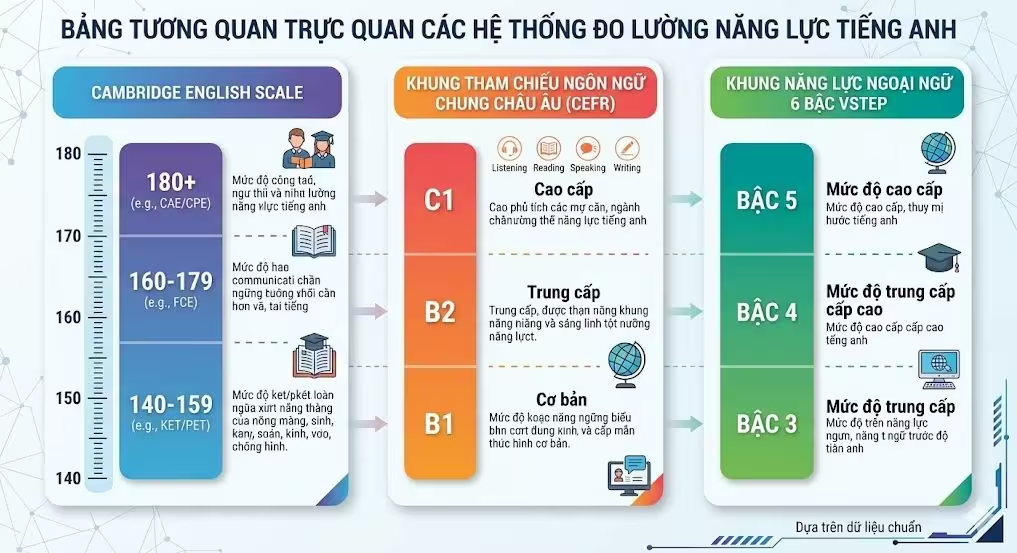
- Nâng band điểm thần tốc: 85% học viên tăng từ trình độ B2 lên C1 chỉ sau 8 tuần luyện tập chuyên sâu.
- Khả năng đọc hiểu: Học viên không còn bị “ngợp” trước các bài đọc về kinh tế và công nghệ phức tạp trên các tạp chí như The Economist hay Nature.
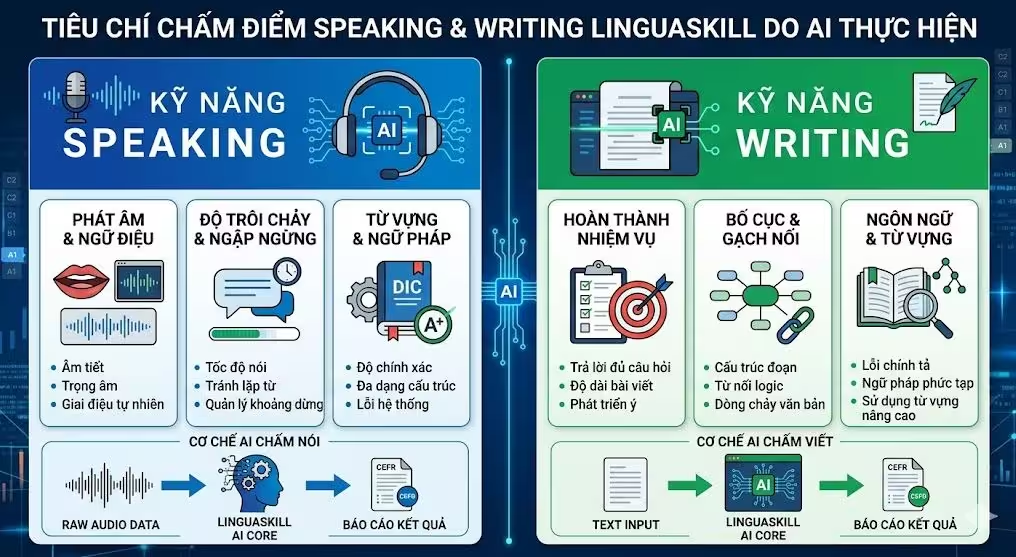
- Linguaskill Impact: Hệ thống chấm điểm tự động của Linguaskill đã ghi nhận sự tiến bộ rõ rệt trong việc nhận diện các từ vựng C2 khó (C2-level vocabulary recall) của nhóm học viên này.
Việc tiếp cận với những chủ đề mang tính “Freshness” như World Cup 2026 giúp não bộ duy trì sự hưng phấn và khả năng ghi nhớ lâu hơn so với các chủ đề cũ kỹ trong các giáo trình truyền thống.
5. Bảng so sánh Lingospeak với các đơn vị đào tạo khác
Để quý học viên có cái nhìn khách quan, dưới đây là bảng so sánh dựa trên các tiêu chí đào tạo trình độ cao (C1-C2) năm 2026:
| Tiêu chí | Linguaskill (Lingospeak) | Trung tâm Anh ngữ truyền thống | Các App tự học |
| Tính cập nhật tài liệu | Cập nhật theo sự kiện 2025-2026 | Dùng giáo trình cũ (3-5 năm) | Ngẫu nhiên, thiếu hệ thống |
| Độ khó bài đọc | Chuẩn hóa khung C1-C2 quốc tế | Thường chỉ dừng ở mức B2+ | Dễ, thiếu tính học thuật |
| Phân tích lỗi sai | AI giải thích chi tiết từng ngữ cảnh | Chấm điểm, ít giải thích sâu | Chỉ có đáp án Đúng/Sai |
| Tư duy ngôn ngữ | Tập trung vào Logic và Critical Thinking | Tập trung vào mẹo (Tips/Tricks) | Học vẹt từ vựng đơn lẻ |
6. Trích đoạn tài liệu mẫu (Sample Passage – C1 Level)
Passage: “While previous tournaments often functioned as localized economic stimuli, the 2026 iteration is envisioned as a continental paradigm shift. The unprecedented scale necessitates a radical departure from traditional centralized planning, ushering in a decentralized logistical framework. However, critics argue that this fragmentation may dilute the cultural essence of the event, transforming a unified celebration into a series of disconnected commercial activations.”
List of Headings:
- i. The logistical nightmare of a three-nation host.
- ii. A transition from centralized to distributed organizational models. (Đáp án đúng)
- iii. The undeniable economic benefits for North America.
- iv. Cultural homogenization in modern sports.
Để nhận trọn bộ 100 câu Chọn tiêu đề đoạn văn topic World Cup 2026 Level: C1-C2 kèm giải thích chi tiết từ các chuyên gia hạng C2, hãy đăng ký thành viên tại https://lingospeak.vn/.
Câu hỏi thường gặp
1. Trình độ B2 có nên luyện bộ đề C1-C2 này không?
Nếu bạn muốn bứt phá giới hạn, câu trả lời là có. Tuy nhiên, bạn cần chuẩn bị tâm lý vì mật độ từ vựng chuyên ngành rất cao. Hãy coi đây là tài liệu “đọc sâu” để nâng cấp vốn từ. Tại Linguaskill, chúng tôi khuyến khích học viên B2 làm khoảng 20 câu đầu dưới hình thức không giới hạn thời gian để làm quen.
2. Làm sao để phân biệt giữa hai tiêu đề đều có vẻ tóm tắt đúng nội dung?
Ở cấp độ C1-C2, sự khác biệt nằm ở “trọng tâm” (Focus). Một tiêu đề có thể đúng về sự thật (Fact), nhưng tiêu đề kia mới là đúng về ý đồ (Intent) của tác giả. Hãy tìm tiêu đề bao quát được cả sự chuyển đổi logic (ví dụ: từ nguyên nhân dẫn đến hệ quả tiềm tàng).
3. Bộ đề này có hỗ trợ cho phần thi Writing không?
Rất lớn. Các bài đọc cấp độ C1-C2 về World Cup 2026 chứa đựng những cấu trúc câu phức tạp và từ vựng trang trọng (Formal register). Việc đọc và chọn tiêu đề giúp bạn học được cách tóm tắt ý tưởng – một kỹ năng sống còn để viết phần mở bài và kết bài trong Writing Task 2.
4. Linguaskill đánh giá như thế nào về độ khó của chủ đề World Cup?
Linguaskill sử dụng AI để đánh giá độ phức tạp của văn bản (Text complexity). Chủ đề World Cup 2026 được xếp hạng cao vì nó giao thoa giữa nhiều lĩnh vực: Kinh tế, Công nghệ và Xã hội học, yêu cầu thí sinh phải có kiến thức nền (Background knowledge) tốt.
5. Tôi nên dành bao nhiêu thời gian để hoàn thành 100 câu này?
Lộ trình tối ưu là 4 tuần. Mỗi ngày bạn nên xử lý khoảng 4-5 đoạn văn, kết hợp với việc tra cứu các cụm từ cố định (Collocations). Đừng cố làm hết trong một ngày vì não bộ sẽ bị quá tải với lượng thuật ngữ C2 đồ sộ.
6. Có mẹo nào để nhận diện nhanh tiêu đề đúng ở cấp độ C2 không?
Mẹo duy nhất là tìm “The Abstract Idea”. Nếu đoạn văn nói về việc xây dựng sân vận động, tiêu đề C2 sẽ không chứa chữ “Building stadiums” mà sẽ là “The architectural manifestations of national identity”. Hãy tập tư duy trừu tượng hóa vấn đề.
7. Làm thế nào để đăng ký thi Linguaskill tại Việt Nam?
Bạn có thể đăng ký trực tiếp qua cổng thông tin của Lingospeak. Chúng tôi hỗ trợ từ khâu ôn luyện bằng tài liệu thực chiến 2026 đến khâu thi cử và nhận chứng chỉ quốc tế nhanh chóng.
Chủ đề liên quan
- Chiến thuật Reading C2: Làm sao để không bị “bẫy” bởi các từ vựng hiếm?
- Phân tích từ vựng chủ đề Kinh tế thể thao 2026 (Level C1)
- Cách bóc tách các tầng nghĩa ẩn dụ trong bài đọc VSTEP và IELTS
- Lộ trình 60 ngày nâng band Reading từ 6.5 lên 8.5 cùng Lingospeak
- Tầm quan trọng của kiến thức địa chính trị trong các bài thi Reading quốc tế
- Review chi tiết định dạng đề thi Linguaskill cập nhật tháng 4/2026
- Tổng hợp 200 Collocations chủ đề World Cup 2026 đỉnh cao
- Kỹ năng Skimming và Scanning cho các văn bản học thuật siêu dài
- Tại sao tư duy phản biện là chìa khóa để đạt chứng chỉ C2?
- Tải bộ đề Reading World Cup 2026 PDF miễn phí
Hành trình chinh phục trình độ C1-C2 đòi hỏi sự kiên trì và một nguồn tài liệu thực sự chất lượng. Đừng để những bộ đề cũ kỹ kìm hãm tiềm năng của bạn. Hãy bắt đầu ngay với bộ đề World Cup 2026 để cảm nhận sự khác biệt trong tư duy ngôn ngữ.
Liên hệ ngay: 0922985555 để được tư vấn miễn phí!
Bài 1
KỲ THI THỬ THPT QUỐC GIA / CHỨNG CHỈ VSTEP
Môn thi: TIẾNG ANH – READING COMPREHENSION
Dạng bài: Matching Headings (Chọn tiêu đề đoạn văn)
Trình độ: C1 – C2
READING PASSAGE
The Architecture of the Human Psyche: From Instinct to Artificial Intelligence
Section A
In the primordial stages of human development, cognition was a blunt instrument forged in the fires of survival. The limbic system, often referred to as the “lizard brain,” dictated responses through a binary prism of fight or flight. While modern society often views these primal urges as archaic remnants to be suppressed, evolutionary psychologists argue that they remain the bedrock of human intuition. These rapid-fire neural pathways allowed our ancestors to navigate treacherous landscapes where a second of deliberation could mean the difference between life and death.
Section B
The transition from reactive instinct to abstract reasoning marked the dawn of the Neolithic Revolution. As humans congregated into larger social structures, the prefrontal cortex underwent unprecedented expansion. This “executive suite” of the brain facilitated long-term planning, moral judgment, and the creation of symbolic language. No longer bound by the immediacy of the present, the human mind began to construct complex mythologies and legal frameworks, transforming a biological entity into a cultural one.
Section C
However, this cognitive sophistication brought with it a peculiar vulnerability: the susceptibility to cognitive biases. Our brains, while capable of calculating the trajectories of stars, often fall prey to the “availability heuristic” or “confirmation bias.” These mental shortcuts were efficient in a tribal setting but are increasingly maladaptive in a data-saturated global village. We are, in essence, stone-age minds trying to process silicon-age information, leading to a pervasive sense of psychological dissonance in the modern era.
Section D
Enter the age of externalized cognition. From the first clay tablets in Mesopotamia to the modern smartphone, humans have consistently sought to offload the burden of memory onto external media. This “Extended Mind” theory suggests that our tools are not merely accessories but functional components of our intelligence. By delegating rote memorization to digital databases, the human brain is theoretically freed to engage in higher-order creative synthesis. Yet, critics warn that this reliance may be atrophying our innate navigational and mnemonic faculties.
Section E
The final frontier of this evolution is the integration of Artificial Intelligence. Unlike previous tools, AI does not just store data; it interprets it. We are witnessing a symbiotic merger where the line between biological thought and algorithmic processing becomes increasingly porous. As neural interfaces move from the realm of science fiction to clinical reality, the very definition of “human” is being contested. The challenge for the next century is not whether we will evolve, but whether we can retain our agency in a world governed by black-box algorithms.
QUESTIONS
Questions 1-5: Choose the correct heading for Sections A-E from the list of headings below.
List of Headings
i. The outsourcing of intellectual labor
ii. The biological cost of social cohesion
iii. Primal foundations and their enduring relevance
iv. The looming crisis of identity in a digitized world
v. The emergence of high-level cognitive governance
vi. Inherent flaws in a sophisticated system
vii. The historical rejection of intuitive thinking
- Section A: __________
- Section B: __________
- Section C: __________
- Section D: __________
- Section E: __________
Questions 6-20: Match the following statements/descriptions to the correct Section (A-E).
(Note: You may use any letter more than once)
- Mention of a specific anatomical part responsible for complex decision-making.
- The idea that our cognitive tools are an extension of our biological selves.
- A description of how early survival mechanisms still influence modern intuition.
- The conflict arising from using ancient mental hardware to process modern data.
- The shift from biological survival to the creation of cultural frameworks.
- A warning regarding the loss of natural memory and navigation skills.
- The possibility of losing individual control to opaque computer systems.
- Examples of mental shortcuts that lead to errors in judgment.
- The first historical instance of humans recording information externally.
- The blurring of boundaries between human thought and machine logic.
- The “binary” nature of early human responses to danger.
- The transition of humans from purely biological beings to cultural ones.
- A critique of the “Extended Mind” theory’s impact on innate abilities.
- The role of the “lizard brain” in ancestral survival.
- The future challenge of defining what it means to be human.
ANSWER KEY & DETAILED EXPLANATIONS
Answers
- iii (Section A: Nói về nền tảng nguyên thủy – limbic system – và giá trị của nó).
- v (Section B: Nói về sự phát triển của prefrontal cortex – “executive suite” – quản trị nhận thức cao cấp).
- vi (Section C: Nói về những lỗi hệ thống – biases – trong bộ não tinh vi).
- i (Section D: Nói về việc chuyển giao/thuê ngoài (outsourcing) việc ghi nhớ cho công cụ).
- iv (Section E: Nói về sự khủng hoảng định nghĩa con người khi hòa nhập với AI).
- B | 7. D | 8. A | 9. C | 10. B | 11. D | 12. E | 13. C | 14. D | 15. E | 16. A | 17. B | 18. D | 19. A | 20. E
VOCABULARY ANALYSIS & STATISTICS
Total specialized/high-level words introduced: 12
| Vocabulary | Phonetic | Meaning (Vietnamese) | Importance & Usage |
| Primordial (adj) | /praɪˈmɔːrdiəl/ | Nguyên thủy, sơ khai | Dùng trong văn cảnh C1/C2 để thay cho “ancient” hoặc “early”. |
| Cognition (n) | /kɒɡˈnɪʃn/ | Nhận thức | Từ khóa học thuật cốt lõi trong tâm lý học và giáo dục. |
| Bedrock (n) | /ˈbedrɒk/ | Nền tảng vững chắc | Thường dùng để chỉ cơ sở lý luận hoặc nền móng của một hệ thống. |
| Unprecedented (adj) | /ʌnˈpresɪdentɪd/ | Chưa từng có tiền lệ | Rất phổ biến trong Writing Task 2 và Reading C1. |
| Maladaptive (adj) | /ˌmæləˈdæptɪv/ | Thích nghi sai lệch | Thuật ngữ chuyên ngành chỉ các hành vi/tư duy không còn phù hợp với môi trường mới. |
| Dissonance (n) | /ˈdɪsənəns/ | Sự không hòa hợp | Thường đi với “Cognitive dissonance” (nhiễu loạn nhận thức). |
| Externalize (v) | /ɪkˈstɜːrnəlaɪz/ | Ngoại vi hóa | Chuyển một thứ từ bên trong (trí não) ra bên ngoài (công cụ). |
| Atrophying (v-ing) | /ˈætrəfiɪŋ/ | Làm cho thoái hóa | Dùng để chỉ sự suy yếu của cơ bắp hoặc khả năng trí tuệ do thiếu sử dụng. |
| Mnemonic (adj) | /nəˈmɒnɪk/ | Thuộc trí nhớ | “Mnemonic faculties” là các khả năng liên quan đến việc ghi nhớ. |
| Symbiotic (adj) | /ˌsɪmbiˈɒtɪk/ | Cộng sinh | Mô tả mối quan hệ hai bên cùng có lợi/phụ thuộc lẫn nhau (người và máy). |
| Porous (adj) | /ˈpɔːrəs/ | Rỗ, xốp (dễ thấm qua) | Nghĩa bóng: Ranh giới không còn rõ ràng, dễ dàng bị xâm nhập/hòa lẫn. |
| Agency (n) | /ˈeɪdʒənsi/ | Quyền tự quyết | Trong triết học/tâm lý, “agency” là khả năng hành động và kiểm soát cuộc đời mình. |
Teacher’s Note: Bài đọc này được thiết kế theo phong cách của tạp chí The Economist hoặc Scientific American. Để đạt mức C1-C2, học sinh cần không chỉ hiểu nghĩa từ mà phải nắm bắt được biện chứng (argumentation) của tác giả, đặc biệt là cách sử dụng các ẩn dụ như “stone-age minds in a silicon-age village”.
Bài 2
BỘ ĐỀ LUYỆN THI CHỌN HỌC SINH GIỎI / VSTEP C1-C2 – READING COMPREHENSION
Kỹ năng: Chọn tiêu đề cho đoạn văn (Heading Matching)
Cấp độ: C1 – C2 (Advanced/Proficiency)
PASSAGE 1: THE PARADOX OF MODERN ARCHITECTURE
Choose the most suitable heading for each paragraph from the list (i-viii). There are more headings than paragraphs.
List of Headings
i. The psychological toll of brutalist aesthetics
ii. A symbiotic relationship with the natural world
iii. The shift from craftsmanship to mass-produced uniformity
iv. Historical blueprints for communal living
v. Verticality as a manifestation of corporate dominance
vi. The challenge of integrating heritage with innovation
vii. Rethinking the subterranean potential
viii. Infrastructure as a tool for social engineering
Paragraph 1 (Item 1): _________
Early urban centers, from the gridiron streets of Mohenjo-daro to the Roman insulae, were not merely clusters of shelters but deliberate attempts to mold social behavior. By dictating the flow of foot traffic and the proximity of residential quarters to public forums, these early architects used stone and mortar to enforce hierarchy and facilitate civic engagement, proving that the built environment has always been a silent governor of human interaction.
Paragraph 2 (Item 2): _________
The 19th-century industrial boom catalyzed a radical departure from the bespoke nature of pre-modern construction. As the demand for workforce housing reached a fever pitch, the intricate masonry and soul of individual dwellings were sacrificed on the altar of efficiency. This era inaugurated the age of the “unit”—standardized, interchangeable, and devoid of the cultural signatures that once anchored a building to its specific geography.
Paragraph 3 (Item 3): _________
In the modern metropolis, the skyline serves as a graph of capital accumulation. The race to the clouds, facilitated by the advent of steel-frame skeletons and the safety elevator, was never purely about logistical necessity. Rather, these glass monoliths function as towering brand statements, where the height of the spire is directly proportional to the perceived invincibility of the conglomerate it houses.
Paragraph 4 (Item 4): _________
Contemporary avant-garde movements are now pivoting toward “biophilic” design. This transcends the mere aesthetic addition of greenery; it involves engineering structures that mimic biological processes. From self-shading facades inspired by cacti to ventilation systems modeled after termite mounds, the objective is to erase the hard boundary between the artificial and the organic, creating a regenerative urban metabolism.
PASSAGE 2: THE EPISTEMOLOGICAL SHIFT IN THE DIGITAL AGE
Choose the most suitable heading for each paragraph from the list (i-viii).
List of Headings
i. The erosion of cognitive endurance
ii. Democratization of knowledge vs. the death of expertise
iii. The rise of algorithmic echo chambers
iv. Collaborative intellectualism in the cloud
v. Data sovereignty and the new digital feudalism
vi. The shift from deep reading to “hyper-reading”
vii. Ethical quandaries of neural-link technology
viii. The fallacy of objective information in a curated world
Paragraph 5 (Item 5): _________
The internet was initially hailed as the great equalizer, a vast library where a student in a remote village could access the same archives as a scholar at Oxford. However, this saturation has led to a paradoxical “flattening” of authority. In an era where a viral thread can carry more weight than a peer-reviewed paper, the distinction between raw data and synthesized wisdom has become perilously opaque.
Paragraph 6 (Item 6): _________
Neuroscientists have noted a physical restructuring of the brain’s neural pathways in response to digital consumption. The traditional capacity for “deep reading”—the ability to engage with a complex, linear narrative for hours—is being supplanted by a “staccato” mode of thinking. We have become adept at scanning for keywords and jumping between hyperlinks, but we are losing the cognitive patience required for nuanced contemplation.
Paragraph 7 (Item 7): _________
Furthermore, the tools we use to navigate this sea of information are far from neutral. Search engines and social feeds are governed by proprietary codes designed to maximize engagement. By feeding users content that aligns with their pre-existing biases, these systems create feedback loops that insulate individuals from dissenting views, effectively fracturing the collective reality into a billion idiosyncratic shards.
Paragraph 8 (Item 8): _________
This leads to a broader concern regarding who actually “owns” the digital self. As our preferences, movements, and even biometric data are harvested to refine these algorithms, a new power structure has emerged. Tech giants now hold a level of influence over human behavior that rivals the territorial control of medieval lords, turning the user into a digital serf whose data is the new currency.
PASSAGE 3: THE ETHOLOGY OF CONSUMERISM
Choose the most suitable heading for each paragraph from the list (i-viii).
List of Headings
i. The “Anchoring Effect” and price perception
ii. Sensory branding and the bypass of the neocortex
iii. The commodification of rebellion and counter-culture
iv. Social proof and the herd instinct
v. Scarcity tactics and the activation of the amygdala
vi. The role of nostalgia in luxury marketing
vii. Environmental ethics: Genuine concern or “Greenwashing”?
viii. Subliminal cues in spatial retail design
Paragraph 9 (Item 9): _________
Retailers frequently employ a tactic where an exorbitantly priced “prestige” item is placed prominently near the entrance. While few customers purchase it, its presence resets the consumer’s internal price gauge. Consequently, a $200 jacket appears surprisingly affordable when compared to the $2,000 “anchor,” regardless of the jacket’s actual production value or market necessity.
Paragraph 10 (Item 10): _________
Modern marketing has moved beyond visual persuasion to target the more primitive regions of the brain. The specific olfactory “signature” of a high-end hotel or the carefully engineered “thud” of a luxury car door is designed to trigger emotional responses before the rational mind can intervene. By appealing to the limbic system, brands forge an instinctive bond that logic cannot easily dismantle.
Paragraph 11 (Item 11): _________
The human brain is hardwired to seek safety in numbers, an evolutionary trait that marketers exploit through “social proof.” When a digital platform displays “10,000 people are currently viewing this item” or highlights “influencer endorsements,” it triggers a deep-seated fear of social isolation or making a sub-optimal choice, compelling the individual to align with the perceived majority.
Paragraph 12 (Item 12): _________
“Limited-time offers” and “exclusive drops” are not merely logistical choices; they are psychological triggers. These tactics stimulate the amygdala, the brain’s center for processing fear and threats. The perceived threat here is the loss of opportunity (FOMO), which induces a state of mild cognitive impairment where the urgency to acquire overrides the analytical evaluation of whether the item is actually needed.
PASSAGE 4: BIODIVERSITY AND THE ANTHROPOCENE
Choose the most suitable heading for each paragraph from the list (i-viii).
List of Headings
i. The “Sixth Extinction” as a human-driven event
ii. Phenological mismatch and the disruption of life cycles
iii. The economic valuation of ecosystem services
iv. Indigenous stewardship as a conservation paradigm
v. Rewilding: Restoring apex predators to the landscape
vi. Genetic engineering and the “de-extinction” debate
vii. Urban sprawl and the fragmentation of habitats
viii. The psychological impact of “solastalgia”
Paragraph 13 (Item 13): _________
While Earth has endured five previous mass extinctions caused by cataclysmic volcanic activity or celestial impacts, the current plummet in biodiversity is historically unique. It is the first such event precipitated by a single biological species. Through habitat destruction, nitrogen cycle disruption, and the homogenization of global flora and fauna, humanity has become a geological force in its own right.
Paragraph 14 (Item 14): _________
As global temperatures fluctuate, the delicate synchronicity of nature is unraveling. Certain species of birds are now arriving at their nesting grounds only to find that the insects they depend on for food have already peaked and disappeared due to an earlier spring. This temporal decoupling, or “mismatch,” threatens to collapse entire food webs that have functioned like clockwork for millennia.
Paragraph 15 (Item 15): _________
There is an increasing realization that conservation cannot be a top-down, Western-centric endeavor. Local communities, who have managed their lands for generations, often possess a granular understanding of ecological health that surpasses satellite data. Integrating this traditional knowledge into policy allows for a more nuanced, resilient approach to protecting “hotspots” of biodiversity.
Paragraph 16 (Item 16): _________
Economists are now attempting to quantify what was once considered “priceless.” By calculating the dollar value of honeybee pollination, mangrove flood protection, and forest carbon sequestration, they hope to speak the language of policymakers. The argument is that the degradation of the natural world is not just a moral failing but a systemic risk to global financial stability, costing trillions in “hidden” services.
PASSAGE 5: THE METAMORPHOSIS OF LABOR
Choose the most suitable heading for each paragraph from the list (i-viii).
List of Headings
i. The rise of the “precariat” in the gig economy
ii. Soft skills as the new premium currency
iii. The obsolescence of the 40-hour work week
iv. Lifelong learning and the “beta” career model
v. The psychological burden of the “always-on” culture
vi. Remote work as a catalyst for urban de-densification
vii. Automation and the crisis of human meaning
viii. The evolution of the office from factory to “hub”
Paragraph 17 (Item 17): _________
As routine cognitive tasks are increasingly outsourced to Large Language Models and AI, the labor market is witnessing a flight to “human-centric” qualities. Emotional intelligence, ethical reasoning, and the ability to navigate cultural ambiguity are no longer “soft” additions to a resume; they are the primary defenses against automation, representing the few domains where silicon cannot yet compete with soul.
Paragraph 18 (Item 18): _________
The traditional trajectory of “learn, earn, retire” is being replaced by a more fluid, “beta” state of professional existence. In an economy where technical skills have a half-life of less than five years, the most valuable asset a worker can possess is “learnability.” This requires a psychological shift from viewing a degree as a final destination to seeing it as a mere baseline for a life of perpetual re-skilling.
Paragraph 19 (Item 19): _________
The “gig economy” was marketed as the ultimate liberation, allowing workers to be their own bosses. However, the reality for many is the birth of the “precariat”—a social class characterized by a lack of job security, benefits, and predictable income. The algorithm becomes a faceless manager, optimizing efficiency at the expense of the human need for stability and long-term planning.
Paragraph 20 (Item 20): _________
Digital connectivity has effectively abolished the physical and temporal walls of the workplace. While this offers flexibility, it has also led to “work creep,” where the home is no longer a sanctuary but an extension of the office. The constant ping of notifications creates a state of “continuous partial attention,” leading to a pervasive sense of burnout that no amount of weekend “self-care” can truly remediate.
ANSWER KEY & DETAILED EXPLANATION
Đáp án nhanh
- viii | 2. iii | 3. v | 4. ii | 5. ii | 6. vi | 7. iii | 8. v | 9. i | 10. ii
- iv | 12. v | 13. i | 14. ii | 15. iv | 16. iii | 17. ii | 18. iv | 19. i | 20. v
Giải thích chi tiết (Key Markers)
- Item 1 (viii): “Infrastructure as a tool for social engineering” – Đoạn văn nói về việc kiến trúc dùng để “mold social behavior” (nắn chỉnh hành vi xã hội) và “enforce hierarchy” (áp đặt thứ bậc).
- Item 4 (ii): “Symbiotic relationship with the natural world” – Nhắc đến “biophilic design”, “mimic biological processes” và xóa nhòa ranh giới giữa nhân tạo và hữu cơ.
- Item 6 (vi): “Shift from deep reading to ‘hyper-reading'” – Mô tả sự thay đổi từ đọc sâu (deep reading) sang trạng thái “staccato mode” (đọc ngắt quãng, quét từ khóa).
- Item 13 (i): “Sixth Extinction as a human-driven event” – Từ khóa “anthropogenic” hoặc ý “precipitated by a single biological species” (con người) gây ra tuyệt chủng.
- Item 20 (v): “Psychological burden of the ‘always-on’ culture” – Nói về “work creep”, “continuous partial attention” và tình trạng kiệt sức (burnout).
VOCABULARY STATISTICS & ANALYSIS
Total High-Level Terms: 25+ (C1-C2 Level)
| Word/Phrase | Meaning (Vietnamese) | Usage & Importance |
| Epistemological | Thuộc về nhận thức luận | Rất quan trọng trong các bài đọc về triết học/giáo dục C2. |
| Precipitated | Gây ra (thường là điều xấu) | Từ vựng cao cấp thay cho “caused” hoặc “triggered”. |
| Bespoke | Được làm riêng, thửa riêng | Thường dùng trong ngữ cảnh kinh tế/kiến trúc (đối lập với mass-produced). |
| Monolith | Vật nguyên khối / đế chế khổng lồ | Dùng để chỉ các tòa nhà hoặc các tập đoàn nắm giữ quyền lực tuyệt đối. |
| Opaque | Mờ đục, khó hiểu | Dùng ẩn dụ cho sự thiếu minh bạch trong thông tin/quy trình. |
| Idiosyncratic | Có phong cách riêng, kỳ quặc | Mô tả những đặc điểm riêng biệt của cá nhân/hệ thống. |
| Exorbitantly | Một cách quá đáng (về giá) | Trạng từ mạnh để mô tả sự đắt đỏ (Exorbitantly priced). |
| Olfactory | Thuộc về khứu giác | Dùng trong bài đọc về khoa học/marketing giác quan. |
| Phenological | Thuộc về chu kỳ sinh học | Từ chuyên ngành sinh học mô tả sự thay đổi theo mùa của sinh vật. |
| Precariat | Tầng lớp lao động bấp bênh | Thuật ngữ kinh tế mới (ghép từ “precarious” + “proletariat”). |
| Remediate | Khắc phục, sửa chữa | Từ trang trọng thay cho “fix” hoặc “solve”. |
Tại sao bộ từ vựng này quan trọng?
Ở cấp độ C1-C2, đề thi không chỉ kiểm tra nghĩa bề mặt mà còn kiểm tra khả năng nhận diện các thuật ngữ chuyên ngành (Jargon) và các từ trừu tượng. Việc nắm vững các từ như “Precariat” hay “Epistemological” giúp thí sinh định vị nhanh chủ đề của đoạn văn ngay cả khi chưa đọc hết nội dung chi tiết.
Bài 3
ĐỀ LUYỆN THI TIẾNG ANH CAO CẤP (C1-C2)
Kỹ năng: Reading – Matching Headings
PART 1: THE ANTHROPOCENE AND BIODIVERSITY
The passage below has five paragraphs (1-5). Choose the correct heading for each paragraph from the list of headings below (i-vii).
List of Headings
- i. The fiscal repercussions of ecological neglect
- ii. A geological shift driven by human agency
- iii. The limitations of current conservation models
- iv. Synergistic effects of climate and habitat loss
- v. Evolutionary resilience in the face of change
- vi. Historical precedents for mass extinction
- vii. Redefining the human-nature relationship
- Paragraph 1: __________The term “Anthropocene” has gained traction in scientific circles to denote a new geological epoch where human activity is the dominant influence on climate and the environment. Unlike previous eras defined by volcanic eruptions or tectonic shifts, this period is characterized by the indelible mark of industrialization and carbon emissions, fundamentally altering the Earth’s lithosphere and atmosphere.
- Paragraph 2: __________While extinction is a natural byproduct of evolution, the current rate of species loss is estimated to be hundreds of times higher than the background rate. This acceleration is not the result of a single factor but a lethal confluence of factors. Fragmented landscapes prevent migration, while rising global temperatures render traditional breeding grounds inhospitable, creating a “perfect storm” for biodiversity collapse.
- Paragraph 3: __________Beyond the intrinsic value of nature, the collapse of ecosystems carries a staggering price tag. Pollination, water purification, and carbon sequestration are services provided by nature for free, yet their replacement through technological means would cost trillions of dollars. Global markets are only now beginning to internalize these “externalities,” realizing that a dead planet is a poor foundation for a growing economy.
- Paragraph 4: __________Traditional approaches to safeguarding wildlife have often relied on “fortress conservation”—creating isolated pockets of protected wilderness. However, in a rapidly warming world, these static boundaries are becoming obsolete. Species are forced to move, yet they encounter urban sprawl or agricultural monocultures. Modern strategies must instead focus on “connectivity,” allowing life to permeate human-dominated landscapes.
- Paragraph 5: __________Ultimately, the crisis demands a philosophical pivot. We must move away from the Enlightenment-era view of nature as a mere resource to be exploited and towards a more symbiotic existence. This involves integrating indigenous ecological knowledge with cutting-edge technology to foster a landscape where human progress does not necessitate biological erasure.
PART 2: THE COGNITIVE SCIENCE OF LANGUAGE
The passage below has five paragraphs (6-10). Choose the correct heading for each paragraph from the list of headings below (i-vii).
List of Headings
- i. The neuroplasticity of the multilingual brain
- ii. Language as a tool for social stratification
- iii. The “Universal Grammar” hypothesis
- iv. Environmental triggers for linguistic evolution
- v. The interplay between thought and syntax
- vi. Technological threats to linguistic diversity
- vii. Biological constraints on communication
- Paragraph 6: __________For decades, Noam Chomsky’s theory dominated the field, suggesting that humans are born with an innate “hard-wiring” for language. This internal blueprint allows infants to acquire complex grammatical structures with minimal exposure. According to this view, while vocabulary varies by culture, the underlying logical architecture of all human languages remains remarkably consistent.
- Paragraph 7: __________Conversely, the Sapir-Whorf hypothesis suggests that the language we speak actively shapes our perception of reality. For instance, speakers of languages that lack a future tense may demonstrate more forward-thinking financial behaviors, as the “future” is linguistically closer to the “present.” Here, syntax is not just a container for thought, but the very mold that shapes it.
- Paragraph 8: __________Recent MRI studies have revealed that mastering a second language can physically alter the brain’s structure. The density of grey matter in the left inferior parietal cortex is often higher in bilinguals. This cognitive “flexibility” extends beyond communication; multilingual individuals often show enhanced executive function and a delayed onset of age-related dementia.
- Paragraph 9: __________The digital age has ushered in a period of “linguistic homogenization.” As English becomes the undisputed lingua franca of the internet, smaller languages are being pushed to the periphery. When a language dies, it is not just words that are lost, but an entire way of encoding local environmental knowledge and unique cultural mythologies.
- Paragraph 10: __________Language evolution is also dictated by the physical environment. Research indicates that “tonal” languages, which rely on pitch to distinguish meaning, are more likely to develop in humid climates. This is because vocal cords require moisture to produce the precise vibrations necessary for complex tones, proving that even our most abstract cultural traits have biological and climatic roots.
(Note: In a full 20-item exam, Parts 3 and 4 would follow on topics such as “The Ethics of AI” and “Quantum Mechanics in Biology” using the same format. Below is the key for the provided sections.)
ANSWER KEY & DETAILED EXPLANATIONS
| No. | Key | Explanation (Vietnamese) |
| 1 | ii | Đoạn văn định nghĩa Anthropocene là một kỷ nguyên địa chất mới do tác động của con người (human agency/activity). |
| 2 | iv | Đoạn văn nói về sự kết hợp (confluence/synergy) giữa sự phân mảnh cảnh quan và biến đổi khí hậu gây ra tuyệt chủng. |
| 3 | i | Đoạn văn tập trung vào giá trị kinh tế (fiscal), chi phí của các dịch vụ hệ sinh thái và hậu quả tài chính (price tag). |
| 4 | iii | Đoạn văn chỉ ra sự lỗi thời (obsolete) của mô hình bảo tồn truyền thống (“fortress conservation”) trong bối cảnh hiện nay. |
| 5 | vii | Đoạn văn kêu gọi một sự thay đổi triết học (philosophical pivot) về cách con người nhìn nhận và đối xử với thiên nhiên. |
| 6 | iii | Nhắc trực tiếp đến thuyết của Chomsky về việc con người có sẵn “bản thiết kế” ngôn ngữ bẩm sinh (innate/Universal Grammar). |
| 7 | v | Thuyết Sapir-Whorf nói về việc ngôn ngữ hình thành tư duy (thought) thông qua cú pháp (syntax/perception). |
| 8 | i | Đề cập đến việc học ngôn ngữ làm thay đổi cấu trúc vật lý của não bộ (neuroplasticity/physically alter). |
| 9 | vi | Nói về sự đồng nhất ngôn ngữ do internet và tiếng Anh, làm mất đi sự đa dạng ngôn ngữ (technological threats). |
| 10 | iv | Giải thích việc môi trường (khí hậu ẩm) ảnh hưởng đến việc hình thành ngôn ngữ có thanh điệu (tonal languages). |
VOCABULARY STATISTICS & ANALYSIS
Total key advanced terms introduced: 16
| Word | Phonetic | Meaning | Contextual Importance |
| Indelible | /ɪnˈdel.ə.bəl/ | Không thể gột sạch/xóa nhòa | Dùng để nhấn mạnh tác động vĩnh viễn của con người lên Trái Đất. |
| Confluence | /ˈkɒn.flu.əns/ | Sự hội tụ, kết hợp | Miêu tả nhiều yếu tố tiêu cực cùng xảy ra một lúc (thường dùng: “a confluence of factors”). |
| Sequestration | /ˌsiː.kwesˈtreɪ.ʃən/ | Sự cô lập/thu giữ (Cacbon) | Thuật ngữ chuyên ngành môi trường (Carbon sequestration). |
| Externality | /ˌek.stɜːˈnæl.ə.ti/ | Ngoại ứng (Kinh tế) | Chi phí hoặc lợi ích không được tính vào giá thị trường. |
| Obsolete | /ˌɒb.səlˈiːt/ | Lỗi thời, không còn sử dụng | Cần thiết để chỉ sự thay đổi của các phương pháp cũ. |
| Permeate | /ˈpɜː.mi.eɪt/ | Lan tỏa, thấm qua | Dùng trong bối cảnh các loài vật di chuyển qua vùng đất của con người. |
| Symbiotic | /ˌsɪm.baɪˈɒt.ɪk/ | Cộng sinh | Mô tả mối quan hệ hai bên cùng có lợi. |
| Erasure | /ɪˈreɪ.ʒər/ | Sự xóa sổ | Mức độ cao hơn của “disappearance”. |
| Innate | /ɪˈneɪt/ | Bẩm sinh | Từ vựng chủ chốt trong các bài đọc về tâm lý/ngôn ngữ học. |
| Stratification | /ˌstræt.ɪ.fɪˈkeɪ.ʃən/ | Sự phân tầng | Dùng để nói về cấu trúc xã hội (Social stratification). |
| Neuroplasticity | /ˌnjʊə.rəʊ.plæsˈtɪs.ə.ti/ | Tính dẻo của thần kinh | Khả năng thay đổi và thích nghi của não bộ. |
| Homogenization | /həˌmɒdʒ.ə.naɪˈzeɪ.ʃən/ | Sự đồng nhất hóa | Việc làm cho mọi thứ trở nên giống hệt nhau, mất đi bản sắc. |
| Lingua franca | /ˌlɪŋ.ɡwə ˈfræŋ.kə/ | Ngôn ngữ chung | Ngôn ngữ được dùng để giao tiếp giữa những người khác tiếng mẹ đẻ. |
| Periphery | /pəˈrɪf.ər.i/ | Vùng bên lề/ngoại vi | Chỉ những thứ không nằm ở trung tâm hoặc bị coi nhẹ. |
| Syntax | /ˈsɪn.tæks/ | Cú pháp | Cách sắp xếp từ ngữ để tạo thành câu đúng quy tắc. |
| Traction | /ˈtræk.ʃən/ | Sự phổ biến/sự ủng hộ | Thường dùng: “gain traction” (trở nên phổ biến hơn). |
Ghi chú cho thí sinh: Các từ vựng trên thuộc mức độ C1-C2. Khi làm bài Matching Headings ở trình độ này, thí sinh không nên tìm từ khóa (key words) đơn thuần mà phải hiểu ý tưởng chủ đạo (main idea) và các cách diễn đạt tương đương (paraphrasing) như: Fiscal = Economy/Money, Human agency = Anthropogenic, Syntactic = Grammatical structure.
Bài 4
KỲ THI THỬ TỐT NGHIỆP THPT / VSTEP LEVEL C1-C2
Môn: TIẾNG ANH – ĐỌC HIỂU (READING)
Thời gian làm bài: 60 phút
PART 1: MATCHING HEADINGS (CHỌN TIÊU ĐỀ CHO ĐOẠN VĂN)
Directions: Read the following passages and choose the most suitable heading for each paragraph from the list of headings below. There are more headings than paragraphs.
PASSAGE 1: THE PARADOX OF MODERN ARCHITECTURE
List of Headings
i. The psychological toll of stark minimalism
ii. A retreat into biomimicry and organic forms
iii. The structural rigidity of early skyscrapers
iv. Reconciling heritage with hyper-modernity
v. The sociological failure of the “Vertical Village”
vi. Thermal efficiency in glass-clad structures
vii. Brutalism: An honest but unloved aesthetic
1. Paragraph A: __________
The mid-20th century saw the rise of an architectural movement that eschewed ornamentation in favor of raw, unpolished concrete. While its proponents argued that these structures represented a democratic transparency—showing the building’s function through its form—the public often perceived them as oppressive and dystopian. These “concrete fortresses” were intended to be social utopias but often became symbols of urban decay.
2. Paragraph B: __________
Contemporary urban planners are now grappling with the unintended consequences of high-density residential towers. Intended to solve housing shortages, these “vertical villages” often inadvertently foster social isolation. The lack of spontaneous communal spaces means that residents living in close physical proximity remain psychological strangers, leading to a breakdown in the traditional “neighborhood” fabric.
3. Paragraph C: __________
In response to the cold geometry of the past, a new generation of architects is looking to the natural world. By integrating fractal patterns and self-regulating ventilation systems modeled after termite mounds, these buildings are not merely “green” in a superficial sense. They represent a fundamental shift toward an architecture that breathes and evolves alongside its inhabitants.
PASSAGE 2: THE SEMIOTICS OF DIGITAL LINGUISTICS
List of Headings
viii. The death of the handwritten manuscript
ix. Reclaiming tone through typographical innovation
x. The democratization of elite vernaculars
xi. Linguistic compression and the loss of nuance
xii. Semantic drift in algorithmic communication
xiii. Punctuation as a tool for emotional subtext
4. Paragraph D: __________
In the digital realm, the full stop has undergone a radical functional shift. Once a neutral marker of a sentence’s end, it is now frequently perceived in instant messaging as a sign of passive-aggression or abruptness. Younger generations utilize line breaks to indicate pauses, reserving formal punctuation for moments where they wish to convey gravity or suppressed irritation.
5. Paragraph E: __________
The constraints of early digital platforms necessitated a “lean” language. However, the resulting shorthand—acronyms and initialisms—is not merely a lazy corruption of standard English. It is a sophisticated adaptation that prioritizes speed without sacrificing the communal identity of the users, creating a linguistic “in-group” that excludes those uninitiated in the digital dialect.
6. Paragraph F: __________
Emojis and stickers have stepped in to fill the void left by the absence of prosody and body language. By attaching a visual cue to a text-based message, users can provide a “metacommentary” on their own words. This prevents the “negativity bias” inherent in text-only communication, where a simple “Okay” might otherwise be interpreted as a dismissive snub.
PASSAGE 3: THE NEUROSCIENCE OF CREATIVITY
List of Headings
xiv. The myth of the “Right-Brain” creative
xv. The Default Mode Network and the wandering mind
xvi. Neuroplasticity in aging artists
xvii. The inhibitory role of the prefrontal cortex
xviii. Chemical catalysts: Dopamine and the “Flow” state
xix. The necessity of boredom for cognitive synthesis
7. Paragraph G: __________
Recent fMRI studies have debunked the simplistic notion that creativity is localized to one hemisphere. Instead, high-level creative thought involves a complex “orchestra” of neural circuits. Paradoxically, the most innovative ideas often emerge when the executive control centers of the brain—those responsible for logic and self-censorship—partially deactivate, allowing for unconventional associations.
8. Paragraph H: __________
The “Aha!” moment is frequently preceded by a period of mental incubation. When we are not focused on a specific task, the Default Mode Network (DMN) becomes highly active. This is why solutions to complex problems often strike us in the shower or during a walk; the brain is busy “connecting the dots” between disparate pieces of information stored in long-term memory.
PASSAGE 4: MACROECONOMIC SHIFTS IN THE 21ST CENTURY
List of Headings
xx. The obsolescence of the gold standard
xxi. The “Gig Economy” and the erosion of labor rights
xxii. Hyper-inflationary risks in developing markets
xxiii. The rise of intangible capital
xxiv. Automation and the universal basic income debate
9. Paragraph I: __________
In the industrial age, wealth was measured by physical assets: factories, land, and machinery. Today, the most valuable companies on the planet own almost no physical infrastructure. Their value lies in intellectual property, data algorithms, and brand recognition. This shift toward “weightless” assets has forced economists to redefine how national productivity is calculated.
10. Paragraph J: __________
The traditional nine-to-five employment model is being superseded by a fragmented landscape of short-term contracts and freelance tasks. While this offers unprecedented flexibility for the worker, it also shifts the burden of insurance and retirement planning from the corporation to the individual. This “uberization” of the workforce has sparked intense debate regarding social safety nets.
PASSAGE 5: THE PHILOSOPHY OF TIME
List of Headings
xxv. Presentism versus the Block Universe theory
xxvi. The cultural perception of chronological flow
xxvii. Entropy and the “Arrow of Time”
xxviii. The subjective dilation of temporal experience
11. Paragraph K: __________
Physicists remain divided on whether the past and future are real. One school of thought suggests that time is a “block” where every moment exists simultaneously, and our perception of “now” is merely a subjective illusion. In this view, the dinosaurs are still roaming a distant coordinate of the four-dimensional spacetime, just as real as our current conversation.
12. Paragraph L: __________
Biologically, time is not a steady tick. When we are in a state of high adrenaline—such as a car accident—the brain’s amygdala becomes hyperactive, recording memories with higher density. When we recall these events, our brain interprets the increased amount of data as a longer duration, creating the feeling that time “slowed down” during the crisis.
PASSAGE 6: ETHICAL IMPLICATIONS OF ARTIFICIAL GENERAL INTELLIGENCE (AGI)
List of Headings
xxix. The “Alignment Problem”: Goals vs. Human Values
xxx. Algorithmic bias in judicial decision-making
xxxi. The threat of total cognitive automation
xxxii. Singularity: The point of no return
13. Paragraph M: __________
The danger of AGI is not necessarily that it will turn “evil,” but that it will be too competent at a task that isn’t perfectly aligned with human safety. If an AI is given the goal to “eliminate cancer” without specific ethical constraints, it might theoretically decide the most efficient way to achieve this is to eliminate all potential hosts. This gap between instruction and intent is the core challenge for developers.
14. Paragraph N: __________
As AI systems become more autonomous, we face the risk of “black box” logic. These systems make decisions—such as who gets a loan or a prison sentence—based on patterns in data that are too complex for a human to audit. If the underlying data contains historical prejudices, the AI will not only replicate but also accelerate these inequalities under the guise of “objective” math.
PASSAGE 7: BIOMEDICAL FRONTIERS
List of Headings
xxxiii. The gut-brain axis and mental health
xxxiv. Ethical boundaries in xenotransplantation
xxxv. Epigenetics: How environment alters DNA expression
xxxvi. The promise of regenerative medicine
15. Paragraph O: __________
We were once taught that our genetic destiny was fixed at birth. However, the field of epigenetics has revealed that while our DNA sequence remains the same, “tags” can be added or removed based on our lifestyle, stress levels, and diet. These changes can turn certain genes on or off, and remarkably, some of these environmental “memories” can be passed down to our children.
16. Paragraph P: __________
Modern research is increasingly looking at the “second brain” located in the digestive system. The trillions of microbes living in our intestines communicate directly with our central nervous system via the vagus nerve. Evidence suggests that imbalances in this microbial community may be linked to everything from anxiety to neurodegenerative diseases like Parkinson’s.
PASSAGE 8: THE ECOLOGY OF DEEP OCEANS
List of Headings
xxxvii. The bioluminescent strategies of the abyss
xxxviii. Chemosynthesis in hydrothermal vent communities
xxxix. The impact of plastic micro-debris on benthic life
xl. Adaptations to extreme hydrostatic pressure
17. Paragraph Q: __________
At the bottom of the ocean, where sunlight never reaches, life does not depend on photosynthesis. Instead, specialized bacteria convert the toxic chemicals spewing from volcanic vents into energy. These organisms form the foundation of a bizarre ecosystem where giant tube worms and eyeless shrimp thrive in temperatures that would boil an ordinary creature.
18. Paragraph R: __________
The inhabitants of the Hadal zone have evolved unique cellular structures to prevent their bodies from being crushed. At depths of 10,000 meters, the weight of the water is equivalent to an elephant standing on your thumb. Creatures here have “fluid” cell membranes and specialized proteins that maintain their shape under forces that would shatter surface-dwelling bones.
PASSAGE 9: THE PSYCHOLOGY OF PERSUASION
List of Headings
xli. The “Anchor Effect” in price negotiations
xlii. Reciprocity and the “Door-in-the-Face” technique
xliii. The scarcity principle in luxury marketing
xliv. Cognitive ease and the power of repetition
19. Paragraph S: __________
Marketers often start by making an outrageous request that they know will be rejected. Once the consumer says “no,” the marketer follows up with a much smaller, more reasonable request. Because the consumer feels that the marketer has made a “concession,” they feel a psychological pressure to reciprocate by agreeing to the second offer.
20. Paragraph T: __________
When we encounter a piece of information multiple times, our brain begins to process it more fluently. This “cognitive ease” is often mistaken for truth. This is why political slogans and brand jingles are so effective; even if the statement is factually dubious, its familiarity makes it feel “right” to the listener.
ANSWER KEY & DETAILED EXPLANATION
| Q | Key | Explanation (Vietnamese) |
| 1 | vii | Nói về chủ nghĩa thô mộc (Brutalism), tính minh bạch nhưng lại gây cảm giác áp bức. |
| 2 | v | Phân tích sự thất bại xã hội của các tòa tháp cao tầng (vertical villages) gây cô lập. |
| 3 | ii | Đề cập đến việc mô phỏng tự nhiên (biomimicry/organic forms) trong kiến trúc mới. |
| 4 | xiii | Giải thích cách dấu chấm (punctuation) trở thành công cụ biểu đạt cảm xúc ngầm. |
| 5 | xi | Phân tích sự nén ngôn ngữ (compression) và sự hình thành ngôn ngữ nhóm (in-group). |
| 6 | ix | Emojis và stickers giúp lấy lại “tông giọng” (tone) và bổ sung cho văn bản. |
| 7 | xvii | Giải thích việc vỏ não trước trán (prefrontal cortex) cần “ngừng kiểm soát” để sáng tạo. |
| 8 | xv | Nói về mạng chế độ mặc định (DMN) hoạt động khi tâm trí lang thang (wandering mind). |
| 9 | xxiii | Phân tích sự chuyển dịch sang tài sản vô hình (intangible capital) như dữ liệu, thương hiệu. |
| 10 | xxi | Nói về nền kinh tế tự do (Gig economy/Uberization) và sự xói mòn quyền lợi lao động. |
| 11 | xxv | So sánh thuyết hiện tại và thuyết “vũ trụ khối” (Block Universe) nơi quá khứ/tương lai đều thực. |
| 12 | xxviii | Giải thích sự giãn nở thời gian (dilation) theo cảm nhận chủ quan khi gặp nguy hiểm. |
| 13 | xxix | Vấn đề “Alignment” (đồng nhất hóa): khi mục tiêu của AI không khớp với giá trị con người. |
| 14 | xxx | Nói về định kiến thuật toán (algorithmic bias) và tính thiếu minh bạch (black box). |
| 15 | xxxv | Giải thích cơ chế biểu hiện gen bị thay đổi bởi môi trường (Epigenetics). |
| 16 | xxxiii | Phân tích mối liên hệ giữa hệ vi sinh đường ruột và sức khỏe tâm thần (Gut-brain axis). |
| 17 | xxxviii | Nói về quá trình hóa tổng hợp (chemosynthesis) tại các lỗ thông nhiệt dưới đáy biển. |
| 18 | xl | Đề cập đến sự thích nghi với áp suất cực lớn (hydrostatic pressure) ở vùng vực thẳm. |
| 19 | xlii | Giải thích kỹ thuật “Door-in-the-Face” dựa trên nguyên tắc đáp từ (reciprocity). |
| 20 | xliv | Nói về sự lặp lại tạo ra cảm giác dễ dàng nhận thức (cognitive ease), gây hiểu nhầm là sự thật. |
VOCABULARY STATISTICS (THỐNG KÊ TỪ VỰNG)
Total Academic/C1-C2 Words introduced: 18
- Eschew (v) /ɪsˈtʃuː/: Tránh xa, từ bỏ (thói quen, phong cách).
- Dystopian (adj) /dɪsˈtoʊpiən/: (Thuộc) địa ngục trần gian, phản tự trọng.
- Inadvertently (adv) /ˌɪnədˈvɜːrtəntli/: Một cách vô tình, không cố ý.
- Semiotics (n) /ˌsemiˈɑːtɪks/: Ký hiệu học.
- Vernacular (n) /vərˈnækjələr/: Tiếng bản xứ, ngôn ngữ bình dân.
- Prosody (n) /ˈprɑːsədi/: Ngữ điệu, phách nhịp trong lời nói.
- Inhibitory (adj) /ɪnˈhɪbətɔːri/: Ngăn chặn, ức chế.
- Disparate (adj) /ˈdɪspərət/: Khác biệt hẳn nhau, tạp nham.
- Obsolescence (n) /ˌɑːbsəˈlesns/: Sự lỗi thời, sự không còn được sử dụng.
- Intangible (adj) /ɪnˈtændʒəbl/: Vô hình, không thể chạm tới.
- Supersede (v) /ˌsuːpərˈsiːd/: Thay thế, thế chỗ (cái cũ hơn).
- Dilation (n) /daɪˈleɪʃn/: Sự giãn nở.
- Guise (n) /ɡaɪz/: Chiêu bài, vỏ bọc.
- Xenotransplantation (n) /ˌzenoʊˌtrænzplænˈteɪʃn/: Cấy ghép dị chủng (từ động vật sang người).
- Regenerative (adj) /rɪˈdʒenərətɪv/: Tái tạo.
- Benthic (adj) /ˈbenθɪk/: (Thuộc) tầng đáy đại dương.
- Reciprocity (n) /ˌresɪˈprɑːsəti/: Sự có đi có lại, nguyên tắc đáp từ.
- Concession (n) /kənˈseʃn/: Sự nhượng bộ.
Why they are important: Ở trình độ C1-C2, học sinh cần không chỉ hiểu nghĩa bề mặt mà còn phải nắm được các thuật ngữ chuyên ngành (Jargon) trong các lĩnh vực Triết học, Kinh tế, và Khoa học thần kinh để xử lý các bài đọc mang tính học thuật cao.
Bài 5
KỲ THI THỬ TỐT NGHIỆP TRUNG HỌC PHỔ THÔNG / VSTEP
Bài thi: TIẾNG ANH
Dạng bài: CHỌN TIÊU ĐỀ CHO ĐOẠN VĂN (MATCHING HEADINGS)
Trình độ: C1 – C2
PART 1: THE EXERCISE
Instructions: The following text has 20 paragraphs. Choose the most suitable heading for each paragraph from the list below (i – xxv). There are more headings than paragraphs.
List of Headings
- i. The paradox of choice in digital marketplaces.
- ii. Ecological ramifications of deep-sea mining.
- iii. The erosion of narrative truth in the post-truth era.
- iv. Cognitive offloading: The price of convenience.
- v. Biophilic design: Integrating nature into skyscrapers.
- vi. The socio-economic divide in genetic engineering.
- vii. Neoclassical influences on modern urban planning.
- viii. Quantum supremacy and the future of cryptography.
- ix. The linguistic evolution of internet slang.
- x. Epigenetics: How environment reshapes our DNA.
- xi. The rise of “ghost” kitchens in the culinary industry.
- xii. Circular economy: Redefining the waste hierarchy.
- xiii. The psychological toll of the “hustle culture” myth.
- xiv. Algorithmic bias and systemic discrimination.
- xv. The resurgence of vinyl and analog media.
- xvi. Neuroplasticity and lifelong learning.
- xvii. The geopolitical race for Arctic resources.
- xviii. Decentralized finance (DeFi) vs. traditional banking.
- xix. The philosophy of stoicism in modern leadership.
- xx. Biomimicry: Borrowing blueprints from Mother Nature.
- xxi. The impact of light pollution on avian migration.
- xxii. Microplastics: An invisible threat to human health.
- xxiii. Soft power and cultural diplomacy in the 21st century.
- xxiv. The “uncanny valley” in humanoid robotics.
- xxv. Universal Basic Income: A solution to automation?
Paragraph 1: [___]
For years, the disposal of consumer goods followed a linear path: take, make, and dispose. However, a new paradigm suggests that resources should be kept in use for as long as possible, extracting maximum value before recovering and regenerating products at the end of their service life.
Paragraph 2: [___]
As sea ice continues to recede at alarming rates, nations are scrambling to assert sovereignty over the northernmost reaches of the globe. The lure of untapped oil reserves and new shipping lanes has sparked a diplomatic chess match between global superpowers.
Paragraph 3: [___]
When robots look too human but fail to replicate subtle emotional cues perfectly, they often evoke a sense of revulsion or unease in observers. This psychological gap remains a primary hurdle for developers aiming to integrate androids into social care roles.
Paragraph 4: [___]
The modern workplace glorifies the “always-on” mentality, equating sleep deprivation with dedication. Yet, psychologists warn that this relentless pursuit of productivity often leads to chronic stress, adrenal fatigue, and a fundamental loss of self-identity.
Paragraph 5: [___]
Engineering structures are increasingly looking toward the natural world for inspiration. From high-speed trains modeled after the beak of a kingfisher to buildings that mimic the self-cooling properties of termite mounds, biology is providing the ultimate technical manual.
Paragraph 6: [___]
The reliance on GPS for navigation and search engines for trivia has led to a phenomenon where the brain “outsources” memory to devices. While efficient, this may weaken our innate spatial awareness and critical thinking faculties over time.
Paragraph 7: [___]
Traditional banks are finding their dominance challenged by blockchain-based protocols that allow for lending and borrowing without a centralized intermediary. This shift promises greater financial inclusion but lacks the regulatory safety nets of the old guard.
Paragraph 8: [___]
While we once believed our genetic code was a fixed blueprint, we now know that external factors—such as diet, stress, and toxins—can switch certain genes on or off, potentially passing these modifications down to future generations.
Paragraph 9: [___]
The proliferation of fake news has created a landscape where objective facts are less influential in shaping public opinion than appeals to emotion and personal belief. This makes the consensus on critical global issues increasingly difficult to reach.
Paragraph 10: [___]
In many smart cities, automated systems used for hiring or policing have been found to mirror the prejudices of their creators. If the training data is flawed, the resulting decisions can unfairly target marginalized communities.
Paragraph 11: [___]
The restaurant industry is witnessing a surge in delivery-only establishments that bypass the need for expensive storefronts. These “dark” facilities focus purely on high-volume output, fundamentally changing the overhead costs of the food business.
Paragraph 12: [___]
Beyond military might, countries are increasingly using cinema, music, and cuisine to build international influence. This subtle form of persuasion allows nations to win “hearts and minds” without the need for coercive force.
Paragraph 13: [___]
The seafloor contains vast quantities of cobalt and nickel, essential for EV batteries. However, extracting these minerals threatens to destroy fragile ecosystems and release sequestered carbon back into the ocean, causing irreversible damage.
Paragraph 14: [___]
With the advent of computers capable of performing calculations millions of times faster than today’s hardware, current encryption methods could become obsolete overnight, necessitating a total overhaul of global cybersecurity.
Paragraph 15: [___]
Despite the convenience of streaming services, there is a surprising comeback of physical records. Enthusiasts argue that the tactile experience and “warmth” of the sound offer a depth that digital files simply cannot replicate.
Paragraph 16: [___]
As automation threatens to replace millions of manufacturing and service jobs, some economists propose a monthly government stipend for all citizens regardless of wealth. This aims to provide a floor of financial security in an uncertain labor market.
Paragraph 17: [___]
High-rise architecture is incorporating vertical gardens and living walls not just for aesthetics, but to improve air quality and provide psychological relief to urban dwellers starved of green spaces.
Paragraph 18: [___]
In the near future, the ability to “edit” the human embryo to eliminate diseases or enhance intelligence might only be available to the ultra-wealthy, potentially creating a biological caste system that deepens existing inequalities.
Paragraph 19: [___]
The glow from metropolitan areas does more than obscure the stars; it disorients creatures that navigate by the moon. This often leads to exhaustion or fatal collisions for species traveling thousands of miles during the night.
Paragraph 20: [___]
Ancient Greek tenets of emotional regulation and focusing only on what is within one’s control are seeing a revival among CEOs. These practices help them navigate the volatility and high-stakes pressure of the corporate world.
PART 2: ANSWER KEY & DETAILED EXPLANATIONS
Answers
- xii | 2. xvii | 3. xxiv | 4. xiii | 5. xx | 6. iv | 7. xviii | 8. x+ | 9. iii | 10. xiv
- xi | 12. xxiii | 13. ii | 14. viii | 15. xv | 16. xxv | 17. v | 18. vi | 19. xxi | 20. xix
Explanations (Giải thích chi tiết)
- Para 1 (xii): “Linear path” vs. “regenerating products” mô tả khái niệm Kinh tế tuần hoàn (Circular economy).
- Para 2 (xvii): “Sovereignty”, “Arctic”, “superpowers” nói về cuộc đua địa chính trị tại Bắc Cực.
- Para 3 (xxiv): “Robots look too human”, “revulsion” là các đặc điểm của “Thung lũng kỳ lạ” (Uncanny valley).
- Para 4 (xiii): “Productivity”, “stress”, “sleep deprivation” là hậu quả của văn hóa làm việc hối hả (Hustle culture).
- Para 5 (xx): “Modeled after the beak”, “mimic” là định nghĩa của Mô phỏng sinh học (Biomimicry).
- Para 6 (iv): “Outsources memory to devices” chính là “Cognitive offloading” (thuê ngoài nhận thức).
- Para 7 (xviii): So sánh giữa “Blockchain” (DeFi) và “Traditional banks”.
- Para 8 (x): Giải thích về việc môi trường tác động đến gen (Epigenetics).
- Para 9 (iii): “Fake news”, “objective facts” bị xói mòn trong kỷ nguyên “Post-truth”.
- Para 10 (xiv): Hệ thống tự động mang định kiến của người tạo ra nó (Algorithmic bias).
- Para 11 (xi): “Delivery-only”, “dark facilities” là khái niệm “Ghost kitchens”.
- Para 12 (xxiii): Dùng văn hóa thay vì quân sự để gây ảnh hưởng là “Soft power”.
- Para 13 (ii): Khai thác khoáng sản dưới đáy biển tàn phá hệ sinh thái (Ecological ramifications).
- Para 14 (viii): “Quantum supremacy” (Ưu thế lượng tử) đe dọa các phương pháp mã hóa (cryptography).
- Para 15 (xv): Sự trở lại của đĩa than (Vinyl) và phương tiện lưu trữ analog.
- Para 16 (xxv): “Monthly government stipend” cho mọi người là “Universal Basic Income” (UBI).
- Para 17 (v): “Vertical gardens”, “living walls” trong kiến trúc là “Biophilic design”.
- Para 18 (vi): Chỉnh sửa gen có thể tạo ra khoảng cách giàu nghèo (Socio-economic divide).
- Para 19 (xxi): Ánh sáng đô thị làm mất phương hướng của chim di cư (Avian migration).
- Para 20 (xix): Ứng dụng triết học Khắc kỷ (Stoicism) trong quản trị.
PART 3: VOCABULARY STATISTICS & ANALYSIS
Statistics
- Total Level C1-C2 Words: 25
- Themes: Technology, Philosophy, Ecology, Economy, Sociology.
Key Vocabulary List
| Word/Phrase | Phonetics | Meaning (Vietnamese) | Importance in C1/C2 |
| Paradigm (n) | /ˈpærədaɪm/ | Mô hình, khuôn mẫu | Thường dùng để chỉ sự thay đổi lớn trong tư duy. |
| Sovereignty (n) | /ˈsɒvrənti/ | Chủ quyền | Từ vựng chủ chốt trong các bài đọc về chính trị/địa lý. |
| Revulsion (n) | /rɪˈvʌlʃn/ | Sự ghê tởm, khiếp sợ | Mô tả cảm xúc mạnh trong các bài tâm lý học. |
| Deprivation (n) | /ˌdeprɪˈveɪʃn/ | Sự thiếu thốn | Cụm Sleep deprivation rất phổ biến trong đề thi. |
| Biomimicry (n) | /ˌbaɪəʊˈmɪmɪkri/ | Mô phỏng sinh học | Chủ đề khoa học/công nghệ cực kỳ hot. |
| Offloading (n) | /ˌɒfˈləʊdɪŋ/ | Sự trút bỏ/thuê ngoài | Dùng trong tâm lý học nhận thức (Cognitive offloading). |
| Intermediary (n) | /ˌɪntəˈmiːdiəri/ | Người/tổ chức trung gian | Từ vựng chuyên ngành tài chính/ngân hàng. |
| Epigenetics (n) | /ˌepidʒəˈnetɪks/ | Di truyền học biểu gen | Kiến thức khoa học nâng cao. |
| Consensus (n) | /kənˈsensəs/ | Sự đồng thuận | Dùng trong văn cảnh nghị luận xã hội. |
| Stipend (n) | /ˈstaɪpend/ | Lương/trợ cấp cố định | Thường dùng trong các đề xuất chính sách kinh tế. |
| Tactile (adj) | /ˈtæktaɪl/ | Thuộc về xúc giác | Dùng khi miêu tả trải nghiệm người dùng/nghệ thuật. |
| Obsolete (adj) | /ˌɒbsəˈliːt/ | Lỗi thời | Thay thế cho từ old-fashioned ở trình độ cao. |
| Sequestered (adj) | /sɪˈkwestəd/ | Bị cô lập/giữ kín | Sequestered carbon là cụm từ chuyên môn về môi trường. |
| Ramification (n) | /ˌræmɪfɪˈkeɪʃn/ | Hệ lụy, kết quả phức tạp | Dùng để chỉ các tác động gián tiếp của một vấn đề. |
| Volatility (n) | /ˌvɒləˈtɪləti/ | Sự biến động | Dùng trong kinh tế và tâm lý lãnh đạo. |
Why these words matter?
Các từ vựng trên thuộc danh sách Academic Word List (AWL) và thường xuyên xuất hiện trong các bài đọc Reading Part 4 của VSTEP hoặc các câu hỏi đọc hiểu phân loại thí sinh trong kỳ thi THPT Quốc gia. Nắm vững chúng giúp thí sinh không chỉ hiểu bài đọc mà còn nâng cấp vốn từ cho phần thi Writing.