Thì Hiện tại đơn (Present Simple) là thì “nhỏ mà có võ” nhất trong tiếng Anh, nên số lượng lưu ý, mẹo, ngoại lệ, cách dùng đặc biệt… là gần như không có giới hạn. Nếu chỉ học cơ bản cân khoảng 30–40 lưu ý là đủ dùng 80% các tình huống. Nếu muốn đạt Band 7.0+ IELTS hoặc nói như người bản xứ cần nắm ít nhất 150–200 lưu ý. Nếu muốn “bá chủ” Present Simple (dạy lại người khác hoặc viết sách ngữ pháp dễ dàng cần tới 350–400 lưu ý, vì còn có thể chia nhỏ theo từng động từ, từng ngữ cảnh siêu cụ thể.
Đọc thêm: Thì hiện tại đơn – Tất tần tật cách dùng, dấu hiệu nhận biệt phần 2
Thì hiện tại đơn – Tất tần tật cách dùng, dấu hiệu nhận biệt phần 3
Thì hiện tại đơn – Tất tần tật cách dùng, dấu hiệu nhận biệt phần 4
Thì hiện tại đơn – Tất tần tật cách dùng, dấu hiệu nhận biệt phần 5
Thì hiện tại đơn – Tất tần tật cách dùng, dấu hiệu nhận biệt phần 6
Khẳng định: S + V(s/es) (He/She/It + động từ thêm s/es)

Thì hiện tại đơn với chủ ngữ ngôi thứ ba số ít (He, She, It, hoặc danh từ số ít) luôn yêu cầu động từ phải thêm “s” hoặc “es”. Quy tắc này giúp câu văn đúng ngữ pháp và nghe tự nhiên. Ví dụ, chúng ta nói “She walks to school every day” chứ không nói “She walk”. Việc thêm “s” thể hiện sự hoà hợp giữa chủ ngữ và động từ.
Khi động từ tận cùng bằng các chữ cái “o”, “s”, “x”, “z”, “ch”, “sh”, người học cần thêm “es” thay vì chỉ “s”. Chẳng hạn, “He goes home at 5 p.m.”, “She watches TV in the evening”, hoặc “The bus passes my house twice a day”. Quy tắc này rất quan trọng vì nếu chỉ thêm “s” thông thường, câu sẽ sai ngay lập tức.
Với động từ tận cùng là phụ âm + “y”, ta phải đổi “y” thành “i” rồi thêm “es”. Ví dụ: “My brother studies English every night”, “The baby cries when she is hungry”. Ngược lại, nếu trước “y” là nguyên âm (a, e, i, o, u), ta chỉ thêm “s” bình thường: “She plays the piano beautifully”, “He always stays at home on Sunday”.
Động từ “have” là ngoại lệ đặc biệt. Khi chủ ngữ là He/She/It, ta dùng “has” chứ không phải “haves”. Vì vậy, ta nói “Lan has long hair”, “This car has four doors”. Người học thường hay nhầm lẫn chỗ này, cần ghi nhớ thật kỹ.
Một số động từ bất quy tắc dù ít nhưng vẫn tồn tại. Ví dụ, “do” biến thành “does”: “He does his homework carefully”. Tương tự, “say” vẫn chỉ thêm “s” thành “says” (phát âm /sɛz/). Những trường hợp này không theo quy tắc chung nên phải học riêng.
Việc nắm chắc cách thêm “s/es” không chỉ giúp viết đúng mà còn phát âm chuẩn. Khi nói nhanh, người bản xứ thường phát âm “s” thành /s/ hoặc /z/ tùy theo âm cuối của động từ. Người học cần luyện nghe và nói nhiều để phân biệt được sự khác nhau này.
Thì hiện tại đơn với “s/es” thường diễn tả thói quen, sự thật hiển nhiên, lịch trình cố định. Vì vậy, việc sử dụng đúng dạng động từ ngôi thứ ba số ít làm cho câu văn trở nên tự nhiên và chuyên nghiệp hơn. Chỉ cần luyện tập thường xuyên, quy tắc này sẽ trở thành phản xạ.
Điền dạng đúng của động từ trong ngoặc:
- She __________ (walk) to the park every morning.
- He __________ (play) football with his friends after school.
- It __________ (rain) a lot in September in my city.
- My father __________ (read) the newspaper at breakfast.
- Lan __________ (speak) English very fluently.
- The dog __________ (bark) at strangers.
- He __________ (like) chocolate ice cream more than vanilla.
- She __________ (go) to bed early on weekdays.
- He __________ (watch) action movies on weekends.
- The bus __________ (pass) my house at 7:30 every morning.
- My dad __________ (fix) everything in the house himself.
- She __________ (brush) her teeth three times a day.
- He __________ (catch) the early train to work.
- The dog __________ (chase) cats in the garden.
- My brother __________ (study) Math until midnight.
- The baby __________ (cry) when she is hungry.
- He __________ (fly) to Singapore twice a month.
- She __________ (play) the piano beautifully.
- My sister __________ (enjoy) playing volleyball.
- Lan __________ (have) long black hair.
- This phone __________ (have) a very big screen.
- He __________ (do) yoga every morning.
- Tom __________ (say) “thank you” in English.
- She __________ (wash) the dishes after dinner.
- The wind __________ (blow) strongly in March.
- My mother __________ (cook) delicious phở on Sundays.
- He __________ (work) as an engineer in a big company.
- The sun __________ (rise) in the east.
- Minh __________ (ride) his bike to school.
- The cat __________ (sleep) on the sofa all day.
- He __________ (call) his grandmother every Sunday evening.
- She __________ (paint) beautiful pictures.
- The river __________ (flow) to the sea.
- Lan __________ (do) the laundry every Monday.
- The chef __________ (mix) the ingredients carefully.
- My sister __________ (teach) English at a primary school.
- He __________ (finish) work at 5 p.m. sharp.
- She __________ (reach) the office before 8 a.m.
- Tom __________ (push) the door gently.
- The child __________ (carry) a heavy backpack to school.
- My father __________ (hurry) to work every morning.
- He __________ (stay) home when it rains.
- The boy __________ (obey) all the school rules.
- She __________ (pay) the bills online every month.
- He __________ (have) breakfast at 6:30 a.m.
- My car __________ (have) four doors and a sunroof.
- The teacher __________ (have) a red pen in her hand.
- This restaurant __________ (have) excellent service.
- He __________ (kiss) his children goodnight.
- The kettle __________ (whistle) when the water boils.
- She __________ (listen) to music while studying.
- Tom __________ (live) near the train station.
- The teacher __________ (explain) the lesson very clearly.
- My brother __________ (collect) old coins.
- The phone __________ (ring) many times a day.
- She __________ (open) the shop at 7 a.m. every day.
- He __________ (clean) his room every Saturday.
- The moon __________ (appear) at night.
- She __________ (drink) green tea in the afternoon.
- The baby __________ (try) to walk every day.
- Lan __________ (worry) about her exam results.
- He __________ (reply) to emails very quickly.
- The dog __________ (bury) bones in the garden.
- Tom __________ (help) his little sister with homework.
- She __________ (miss) her family when she travels.
- He __________ (fish) at the lake every weekend.
- The machine __________ (beep) when it’s ready.
- Lan __________ (guess) the answer correctly most of the time.
- My dad __________ (drive) to work and __________ (listen) to the news.
- She __________ (watch) TV and __________ (eat) popcorn in the evening.
- The cat __________ (catch) mice and __________ (sleep) all day.
- He __________ (go) jogging and __________ (drink) coffee every morning.
- My sister __________ (play) the guitar and __________ (sing) very well.
- Tom __________ (have) a new bike and __________ (ride) it to school.
- Lan __________ (study) English and __________ (listen) to BBC podcasts.
- He __________ (do) his homework very carefully.
- She always __________ (say) “hello” to everyone.
- The baby __________ (smile) when he __________ (see) his mother.
- My father __________ (hurry) but never __________ (forget) to kiss us goodbye.
- This car __________ (have) five seats and __________ (run) very smoothly.
- He __________ (finish) work early and then __________ (play) football.
- She __________ (have) curly hair and always __________ (wear) glasses.
- The train __________ (cross) the bridge slowly twice a day.
- My dog __________ (have) a loud bark but never __________ (bite).
- Lan __________ (cry) during sad movies but quickly __________ (smile) again.
- My little brother __________ (cry) loudly but __________ (stop) immediately when he gets candy.
- She __________ (study) French at university and __________ (speak) it quite well now.
- The old clock on the wall __________ (strike) twelve times at midnight and __________ (wake) everyone up.
- He __________ (have) a small tattoo on his arm and always __________ (wear) short-sleeved shirts in summer.
- This coffee machine __________ (beep) three times and then automatically __________ (switch) itself off.
- Lan __________ (fly) to Hanoi every month and __________ (visit) her grandparents for two days.
- The teacher __________ (write) on the board and __________ (explain) everything at the same time.
- My dog __________ (chase) every motorbike that __________ (pass) our gate.
- He __________ (do) the shopping on Saturday and __________ (cook) for the whole week.
- The baby __________ (try) to talk and often __________ (say) only “mama” and “papa”.
- She __________ (worry) a lot before exams but always __________ (pass) with high scores.
- This smartphone __________ (have) an excellent camera and __________ (take) amazing photos even at night.
- Tom __________ (hurry) to the station but the train usually __________ (leave) on time anyway.
- My mother __________ (buy) fresh flowers every Monday and __________ (put) them in the living room.
- He __________ (watch) the news every evening and then __________ (discuss) it with my father.
Đáp án thì hiện tại đơn
- walks
- plays
- rains
- reads
- speaks
- barks
- likes
- goes
- watches
- passes
- fixes
- brushes
- catches
- chases
- studies
- cries
- flies
- plays
- enjoys
- has
- has
- does
- says
- washes
- blows
- cooks
- works
- rises
- rides
- sleeps
- calls
- paints
- flows
- does
- mixes
- teaches
- finishes
- reaches
- pushes
- carries
- hurries
- stays
- obeys
- pays
- has
- has
- has
- has
- kisses
- whistles
- listens
- lives
- explains
- collects
- rings
- opens
- cleans
- appears
- drinks
- tries
- worries
- replies
- buries
- helps
- misses
- fishes
- beeps
- guesses
- drives – listens
- watches – eats
- catches – sleeps
- goes – drinks
- plays – sings
- has – rides
- studies – listens
- does
- says
- smiles – sees
- hurries – forgets
- has – runs
- finishes – plays
- has – wears
- crosses
- has – bites
- cries – smiles
- cries – stops
- studies – speaks
- strikes – wakes
- has – wears
- beeps – switches
- flies – visits
- writes – explains
- chases – passes
- does – cooks
- tries – says
- worries – passes
- has – takes
- hurries – leaves
- buys – puts
- watches – discusses
| Thì hiện tại đơn, chủ ngữ He/She/It hoặc danh từ số ít, động từ phải thêm “s” hoặc “es”. Động từ tận cùng o, s, x, z, ch, sh thêm “es”; tận cùng phụ âm + y thì đổi y thành i + es; have → has. Quy tắc này thể hiện sự hoà hợp chủ-vị và giúp câu đúng ngữ pháp, tự nhiên. |
Phủ định: S + do/does + not + V nguyên thể
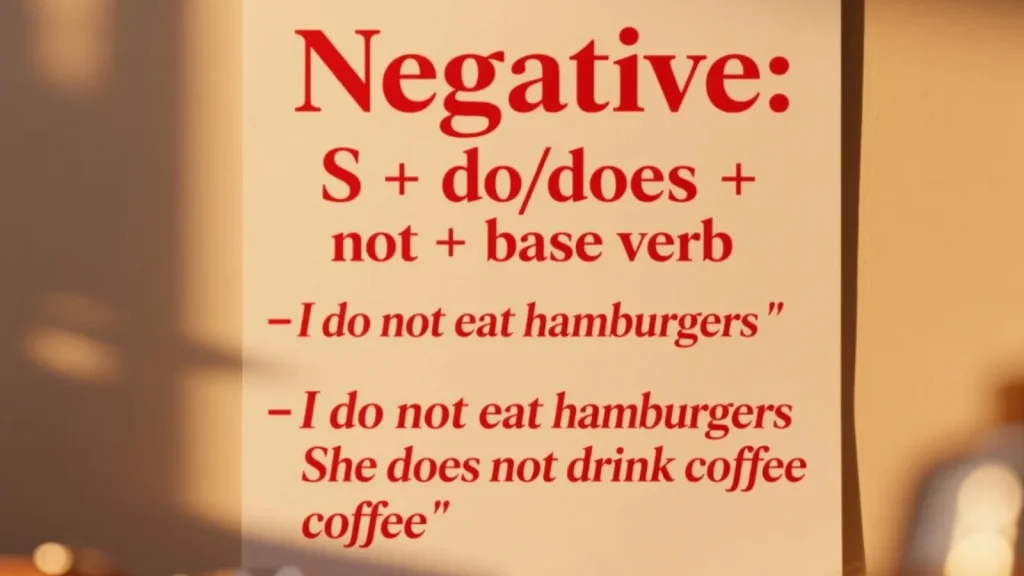
Thì Hiện tại đơn (Present Simple) được dùng để diễn tả thói quen, sự thật hiển nhiên hoặc hành động lặp lại thường xuyên. Khi muốn phủ định một hành động ở thì này, ta phải dùng trợ động từ “do” hoặc “does” kèm “not” trước động từ nguyên thể. Công thức cơ bản là: Subject + do/does + not + verb (nguyên mẫu không “to”).
Với chủ ngữ I/You/We/They, ta luôn dùng “do not”. Ví dụ: I do not like coffee. We do not play football every day. They do not speak French. Người học cần nhớ “do not” thường được viết tắt thành “don’t” trong văn nói và văn viết thân mật.
Ngược lại, với chủ ngữ He/She/It, ta phải dùng “does not”. Lúc này động từ chính không còn chia ở dạng số ít nữa mà trở về nguyên thể. Ví dụ: She does not watch TV in the morning. He does not go to school by bus. It does not rain much in summer. Viết tắt phổ biến là “doesn’t”.
Khi đặt câu hỏi phủ định (negative question), cấu trúc vẫn giữ nguyên trật tự đảo của câu hỏi nhưng thêm “not”. Ví dụ: Don’t you like chocolate? Doesn’t he live near here? Loại câu hỏi này thường mang ý ngạc nhiên hoặc mong đợi câu trả lời “có”.
Một lỗi rất hay gặp của người Việt là quên trợ động từ hoặc vẫn giữ nguyên dạng động từ có “s/es” khi phủ định. Sai: She not likes tea. Đúng: She does not like tea. Hãy luôn nhớ: chỉ có động từ “to be” mới phủ định trực tiếp (is not, are not), còn tất cả động từ thường đều cần “do/does not”.
Trong văn phong trang trọng hoặc văn viết, nên dùng dạng đầy đủ “do not”, “does not”. Trong giao tiếp hàng ngày, “don’t” và “doesn’t” được chấp nhận rộng rãi và tự nhiên hơn. Việc nắm chắc quy tắc này sẽ giúp câu văn phủ định của bạn vừa đúng ngữ pháp vừa nghe rất tự nhiên như người bản xứ.
Bài tập
- I __________ (not like) waking up early on Sunday.
- You __________ (not play) video games every night.
- We __________ (not eat) fast food very often.
- They __________ (not speak) Japanese at home.
- I __________ (not drink) coffee in the evening.
- You __________ (not watch) horror movies.
- We __________ (not go) to the gym on weekends.
- They __________ (not live) in the city center.
- I __________ (not understand) this math problem.
- You __________ (not need) an umbrella today.
- We __________ (not visit) our grandparents every week.
- They __________ (not study) French this year.
- I __________ (not drive) to work.
- You __________ (not listen) to classical music.
- We __________ (not have) a car.
- They __________ (not swim) in the sea in winter.
- I __________ (not wear) jeans to the office.
- You __________ (not read) novels.
- We __________ (not cook) dinner on Friday evenings.
- They __________ (not believe) in ghosts.
- He __________ (not like) chocolate ice cream.
- She __________ (not go) to bed before 11 p.m.
- It __________ (not rain) much in April here.
- My brother __________ (not play) the piano.
- Lan __________ (not watch) cartoons anymore.
- The cat __________ (not eat) vegetables.
- He __________ (not speak) Spanish fluently.
- She __________ (not drive) very fast.
- Tom __________ (not do) his homework in the morning.
- The sun __________ (not rise) in the west.
- My father __________ (not smoke) cigarettes.
- She __________ (not have) long hair now.
- He __________ (not work) on Sundays.
- The dog __________ (not bite) strangers.
- This phone __________ (not have) a good camera.
- Lan __________ (not study) Math on Saturday.
- He __________ (not fly) to London every month.
- She __________ (not cry) during sad movies.
- The baby __________ (not sleep) all night.
- My sister __________ (not play) tennis very well.
- He __________ (not catch) the bus at 7 a.m.
- She __________ (not wash) the dishes every day.
- It __________ (not snow) in Ho Chi Minh City.
- The teacher __________ (not give) us too much homework.
- He __________ (not forget) his keys anymore.
- She __________ (not wear) high heels to school.
- My car __________ (not start) in cold weather.
- The train __________ (not arrive) late usually.
- He __________ (not brush) his teeth only once a day.
- She __________ (not miss) the bus very often.
- I __________ (not want) tea, thank you.
- He __________ (not want) to join us tonight.
- We __________ (not need) help with this exercise.
- She __________ (not need) glasses to read.
- They __________ (not know) the answer.
- Lan __________ (not know) how to swim.
- You __________ (not look) happy today.
- The weather __________ (not look) good for tomorrow.
- We __________ (not see) each other very often.
- He __________ (not see) the board clearly.
- They __________ (not agree) with the new rules.
- My mother __________ (not agree) with my decision.
- I __________ (not mind) waiting a few minutes.
- The baby __________ (not mind) loud music.
- You __________ (not seem) tired after the trip.
- She __________ (not seem) interested in the movie.
- We __________ (not care) about the score.
- This shop __________ (not close) before 10 p.m.
- They __________ (not feel) cold in this room.
- He __________ (not feel) well today.
- Don’t you __________ (like) this song?
- Doesn’t she __________ (live) in District 1?
- Don’t they __________ (play) football on Sunday?
- Doesn’t he __________ (speak) English very well?
- Don’t we __________ (have) class tomorrow?
- Doesn’t the train __________ (leave) at 8:15?
- Don’t you __________ (want) to come with us?
- Doesn’t Lan __________ (study) at Ton Duc Thang University?
- Don’t your parents __________ (know) about this?
- Doesn’t it __________ (rain) a lot in July?
- Don’t children __________ (love) cartoons?
- Doesn’t Tom __________ (work) at your company?
- Don’t you __________ (remember) me?
- Doesn’t the shop __________ (open) on Sunday?
- Don’t they __________ (understand) the lesson?
- My sister __________ (not eat) meat because she __________ (be) vegetarian.
- He __________ (not go) out much because he __________ (not have) free time.
- We __________ (not watch) TV in the evening because we __________ (prefer) reading.
- The dog __________ (not bark) at night unless someone __________ (pass) the house.
- Lan __________ (not use) Facebook anymore because she __________ (find) it boring.
- They __________ (not travel) by plane because they __________ (not like) flying.
- My father __________ (not drink) alcohol and he __________ (not smoke) either.
- She __________ (not wear) makeup to school because the teacher __________ (not allow) it.
- I __________ (not play) games on my phone because it __________ (not have) enough memory.
- He __________ (not call) me every day because he __________ (be) very busy at work.
- The children __________ (not make) noise when their father __________ (sleep).
- This restaurant __________ (not serve) breakfast on Monday because it __________ (open) at 11 a.m.
- We __________ (not visit) that museum because it __________ (close) on Tuesday.
- She __________ (not buy) expensive clothes because she __________ (not earn) much money.
- Tom __________ (not do) his homework early because he __________ (think) it’s easy.
Đáp án
- don’t like
- don’t play
- don’t eat
- don’t speak
- don’t drink
- don’t watch
- don’t go
- don’t live
- don’t understand
- don’t need
- don’t visit
- don’t study
- don’t drive
- don’t listen
- don’t have
- don’t swim
- don’t wear
- don’t read
- don’t cook
- don’t believe
- doesn’t like
- doesn’t go
- doesn’t rain
- doesn’t play
- doesn’t watch
- doesn’t eat
- doesn’t speak
- doesn’t drive
- doesn’t do
- doesn’t rise
- doesn’t smoke
- doesn’t have
- doesn’t work
- doesn’t bite
- doesn’t have
- doesn’t study
- doesn’t fly
- doesn’t cry
- doesn’t sleep
- doesn’t play
- doesn’t catch
- doesn’t wash
- doesn’t snow
- doesn’t give
- doesn’t forget
- doesn’t wear
- doesn’t start
- doesn’t arrive
- doesn’t brush
- doesn’t miss
- don’t want
- doesn’t want
- don’t need
- doesn’t need
- don’t know
- doesn’t know
- don’t look
- doesn’t look
- don’t see
- doesn’t see
- don’t agree
- doesn’t agree
- don’t mind
- doesn’t mind
- don’t seem
- doesn’t seem
- don’t care
- doesn’t close
- don’t feel
- doesn’t feel
- Don’t you like
- Doesn’t she live
- Don’t they play
- Doesn’t he speak
- Don’t we have
- Doesn’t the train leave
- Don’t you want
- Doesn’t Lan study
- Don’t your parents know
- Doesn’t it rain
- Don’t children love
- Doesn’t Tom work
- Don’t you remember
- Doesn’t the shop open
- Don’t they understand
- doesn’t eat … is
- doesn’t go … doesn’t have
- don’t watch … prefer
- doesn’t bark … passes
- doesn’t use … finds
- don’t travel … don’t like
- doesn’t drink … doesn’t smoke
- doesn’t wear … doesn’t allow
- don’t play … doesn’t have
- doesn’t call … is
- don’t make … sleeps
- doesn’t serve … opens
- don’t visit … closes
- doesn’t buy … doesn’t earn
- doesn’t do … thinks
| Phủ định thì Hiện tại đơn: S + do/does + not + V nguyên thể. Dùng “do not” (don’t) với I/you/we/they; dùng “does not” (doesn’t) với he/she/it. Động từ chính luôn ở dạng nguyên mẫu, không chia “s/es”. Đây là quy tắc bắt buộc với mọi động từ thường. |
Nghi vấn: Do/Does + S + V nguyên thể?
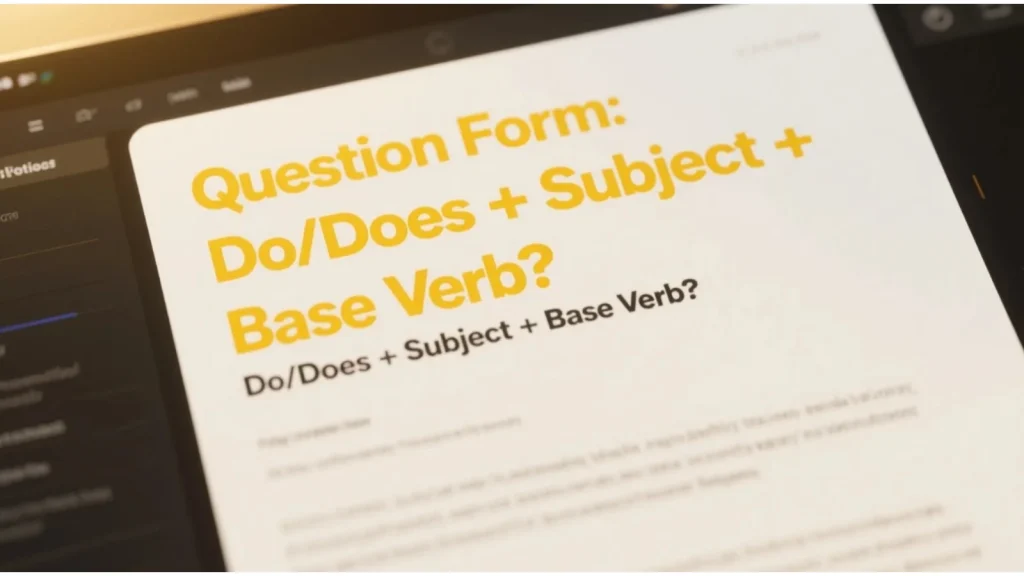
Trong thì hiện tại đơn, để đặt câu hỏi Yes/No, ta đảo trợ động từ do hoặc does lên đầu câu, theo cấu trúc: Do/Does + S + V nguyên thể? Với chủ ngữ I/You/We/They và danh từ số nhiều, ta dùng “Do”; còn He/She/It và danh từ số ít thì dùng “Does”. Động từ chính luôn giữ nguyên dạng cơ bản, không thêm s/es dù chủ ngữ là ngôi thứ ba.
Ví dụ: “You like chocolate” → “Do you like chocolate?”; “Lan speaks French” → “Does Lan speak French?”; “The children play in the park” → “Do the children play in the park?”. Cách đảo trợ động từ này giúp câu hỏi trở nên tự nhiên và đúng ngữ pháp tiếng Anh.
Khi dùng “Does”, nhiều người học vẫn mắc lỗi giữ nguyên “s” ở động từ chính: “Does she likes…?” là sai. Phải viết “Does she like…?”. Lý do giống như ở câu phủ định: “does” đã mang dấu hiệu ngôi thứ ba, nên động từ chính phải trở về nguyên thể không “s”.
Câu hỏi với động từ “to be” và động từ khuyết thiếu không dùng do/does. Ta nói “Is he at home?”, “Can you swim?”, chứ không nói “Does he be at home?”. Người học cần ghi nhớ rõ sự khác biệt này để tránh nhầm lẫn giữa các loại động từ.
Trong giao tiếp thực tế, người bản xứ thường thêm từ nghi vấn ở cuối để tăng tính thân thiện: “You live here, don’t you?”; “She works hard, doesn’t she?”. Đây gọi là câu hỏi đuôi (question tag), vẫn dựa trên quy tắc do/does của thì hiện tại đơn.
Câu hỏi Yes/No hiện tại đơn rất phổ biến khi hỏi về thói quen, sở thích, sự thật thường xuyên. Ví dụ: “Do you drink coffee every morning?”, “Does the supermarket open on Sunday?”, “Do your parents watch TV in the evening?”. Nhờ cấu trúc rõ ràng này, người nghe dễ trả lời ngắn gọn bằng Yes hoặc No.
Nắm vững cách đặt câu hỏi “Do/Does + S + V nguyên thể?” giúp người học giao tiếp tự tin hơn. Chỉ cần luyện tập thường xuyên việc đảo trợ động từ và giữ động từ chính ở dạng nguyên mẫu, đặc biệt với “does”, bạn sẽ không còn lo lắng khi hỏi hoặc trả lời bằng thì hiện tại đơn.
- _____ you _____ (like) Vietnamese phở?
- _____ your friends _____ (play) football every weekend?
- _____ you _____ (speak) English at home?
- _____ they _____ (live) in Hanoi?
- _____ we _____ (have) English class on Monday?
- _____ your parents _____ (watch) TV in the evening?
- _____ the children _____ (go) to bed at 9 p.m.?
- _____ you _____ (drink) coffee every morning?
- _____ your brothers _____ (study) at university?
- _____ they _____ (visit) their grandparents every Sunday?
- _____ you and Lan _____ (walk) to school together?
- _____ cats _____ (sleep) a lot during the day?
- _____ your teachers _____ (give) too much homework?
- _____ you _____ (use) TikTok every day?
- _____ people in your country _____ (eat) rice every day?
- _____ we _____ (need) an umbrella today?
- _____ your dogs _____ (bark) at strangers?
- _____ they _____ (travel) by train or by plane?
- _____ you _____ (listen) to music while studying?
- _____ the students _____ (do) their homework carefully?
- _____ you _____ (want) to eat pizza tonight?
- _____ your classmates _____ (know) the answer?
- _____ birds _____ (fly) south in winter?
- _____ we _____ (finish) school at 5 p.m.?
- _____ your friends _____ (play) online games every night?
- _____ they _____ (speak) three languages?
- _____ you _____ (remember) my name?
- _____ the buses _____ (come) on time in your city?
- _____ you _____ (read) books in English?
- _____ your parents _____ (work) on Saturday?
- _____ Lan _____ (study) English every day?
- _____ your father _____ (drive) to work?
- _____ the sun _____ (rise) in the east?
- _____ Tom _____ (play) the guitar very well?
- _____ she _____ (have) long hair?
- _____ your dog _____ (like) cats?
- _____ he _____ (go) jogging every morning?
- _____ the baby _____ (cry) a lot at night?
- _____ this phone _____ (have) a good camera?
- _____ Minh _____ (do) his homework in the evening?
- _____ your mother _____ (cook) dinner every day?
- _____ the train _____ (leave) at 7:30 a.m.?
- _____ she _____ (watch) Korean dramas?
- _____ your car _____ (start) quickly in the morning?
- _____ he _____ (speak) Japanese fluently?
- _____ the cat _____ (sleep) on your bed?
- _____ Lan _____ (wear) glasses?
- _____ your brother _____ (play) basketball after school?
- _____ it _____ (rain) a lot in July?
- _____ the supermarket _____ (open) on Sunday?
- _____ she _____ (work) as a teacher?
- _____ your sister _____ (sing) beautifully?
- _____ he _____ (wake) up early on weekends?
- _____ this restaurant _____ (serve) vegetarian food?
- _____ the movie _____ (start) at 8 p.m.?
- _____ Tom _____ (need) help with Math?
- _____ your dad _____ (read) the newspaper every morning?
- _____ she _____ (fly) to Singapore every month?
- _____ the dog _____ (chase) cats?
- _____ your teacher _____ (explain) the lesson clearly?
- _____ he _____ (finish) work at 5 p.m.?
- _____ the kettle _____ (whistle) when the water boils?
- _____ Lan _____ (worry) about exams?
- _____ your phone _____ (ring) many times a day?
- _____ she _____ (brush) her teeth three times a day?
- _____ the bus _____ (pass) your house every 10 minutes?
- _____ he _____ (catch) the early bus?
- _____ this shop _____ (close) at 10 p.m.?
- _____ your little brother _____ (cry) when he’s hungry?
- _____ the baby _____ (smile) when he sees you?
- You live in District 3, __________________?
- She doesn’t smoke, __________________?
- They play tennis every Saturday, __________________?
- Tom works at Google, __________________?
- We don’t have school tomorrow, __________________?
- Your father drives very fast, __________________?
- Lan speaks French very well, __________________?
- The children don’t like vegetables, __________________?
- He doesn’t drink coffee, __________________?
- You understand the lesson, __________________?
- This phone doesn’t work properly, __________________?
- She has two cats, __________________?
- They don’t visit us very often, __________________?
- Your sister studies in Australia, __________________?
- It rains a lot in summer here, __________________?
- _____ your parents and you _____ (go) to the beach every summer?
- _____ the teacher _____ (give) homework every day?
- _____ Lan _____ (not eat) pork because she _____ (be) Muslim?
- _____ you _____ (want) tea or coffee?
- _____ he _____ (play) games all day and _____ (not study)?
- _____ the children _____ (make) a lot of noise in the afternoon?
- _____ this bus _____ (stop) near your school?
- _____ your best friend _____ (live) far from here?
- _____ she _____ (work) hard but _____ (not earn) much money?
- _____ dogs _____ (chase) cats all the time?
- _____ you _____ (feel) tired after school?
- _____ the movie theater _____ (open) at weekends only?
- _____ Tom and Minh _____ (play) football together every Friday?
- _____ your mother _____ (buy) groceries every Monday?
- _____ it _____ (snow) in Sa Pa in winter?
Đáp án
- Do you like
- Do your friends play
- Do you speak
- Do they live
- Do we have
- Do your parents watch
- Do the children go
- Do you drink
- Do your brothers study
- Do they visit
- Do you and Lan walk
- Do cats sleep
- Do your teachers give
- Do you use
- Do people in your country eat
- Do we need
- Do your dogs bark
- Do they travel
- Do you listen
- Do the students do
- Do you want
- Do your classmates know
- Do birds fly
- Do we finish
- Do your friends play
- Do they speak
- Do you remember
- Do the buses come
- Do you read
- Do your parents work
- Does Lan study
- Does your father drive
- Does the sun rise
- Does Tom play
- Does she have
- Does your dog like
- Does he go
- Does the baby cry
- Does this phone have
- Does Minh do
- Does your mother cook
- Does the train leave
- Does she watch
- Does your car start
- Does he speak
- Does the cat sleep
- Does Lan wear
- Does your brother play
- Does it rain
- Does the supermarket open
- Does she work
- Does your sister sing
- Does he wake
- Does this restaurant serve
- Does the movie start
- Does Tom need
- Does your dad read
- Does she fly
- Does the dog chase
- Does your teacher explain
- Does he finish
- Does the kettle whistle
- Does Lan worry
- Does your phone ring
- Does she brush
- Does the bus pass
- Does he catch
- Does this shop close
- Does your little brother cry
- Does the baby smile
- don’t you?
- does she?
- don’t they?
- doesn’t he?
- do we?
- doesn’t he?
- doesn’t she?
- do they?
- does he?
- don’t you?
- does it?
- doesn’t she?
- do they?
- doesn’t she?
- doesn’t it?
- Do your parents and you go
- Does the teacher give
- Doesn’t Lan eat … is she
- Do you want
- Does he play … doesn’t he study
- Do the children make
- Does this bus stop
- Does your best friend live
- Does she work … doesn’t she earn
- Do dogs chase
- Do you feel
- Does the movie theater open
- Do Tom and Minh play
- Does your mother buy
- Does it snow
| Câu hỏi Yes/No thì hiện tại đơn: Do/Does + S + V nguyên thể? I/You/We/They → Do; He/She/It → Does. Động từ chính luôn ở dạng nguyên mẫu, không thêm s/es. Dùng hỏi về thói quen, sở thích, sự thật thường xuyên. Ví dụ: Do you play tennis? Does he live nearby? |
Động từ “to be”: am/is/are (không dùng do/does)
Động từ “to be” (am/is/are) là trường hợp đặc biệt trong thì hiện tại đơn vì nó tự mang đầy đủ ý nghĩa mà không cần trợ động từ do/does. Do đó, khi khẳng định, phủ định hay nghi vấn với “to be”, ta tuyệt đối không dùng do/does. Quy tắc này giúp người học tránh được lỗi sai rất phổ biến khi mới bắt đầu.
Trong câu khẳng định, ta chỉ cần dùng đúng dạng của “to be” theo chủ ngữ: I am, He/She/It is, You/We/They are. Ví dụ: “She is a doctor”, “They are happy today”, “I am tired after work”. Câu văn trở nên ngắn gọn và tự nhiên hơn so với các động từ thường.
Ở dạng phủ định, ta chỉ thêm “not” ngay sau “to be”: am not, is not (isn’t), are not (aren’t). Ta nói “He is not at home”, “We aren’t students”, chứ không bao giờ nói “He does not be at home”. Nhiều người Việt hay nhầm lẫn vì quen tư duy dùng do/does với mọi động từ.
Khi đặt câu hỏi, chỉ cần đảo “to be” lên đầu: Am I…?, Is he…?, Are you…? Ví dụ: “Is Lan in the classroom?”, “Are the children ready?”, “Am I late?”. Cách đảo này đơn giản hơn rất nhiều so với cấu trúc Do/Does + S + V của động từ thường.
Vì “to be” đã là trợ động từ chính, nên nó còn xuất hiện trong thì tiếp diễn (be + V-ing) và thể bị động (be + V3/ed). Tuy nhiên, ở thì hiện tại đơn, vai trò chính của nó là diễn tả trạng thái, nghề nghiệp, tính chất, tuổi tác, quốc tịch. Ví dụ: “This book is interesting”, “My parents are teachers”.
Trong giao tiếp thực tế, dạng rút gọn của “to be” được dùng rất nhiều: I’m, you’re, he’s, she’s, it’s, we’re, they’re. Dạng phủ định cũng rút gọn: isn’t, aren’t (riêng “am not” không có dạng rút gọn thông dụng). Việc dùng dạng rút gọn giúp câu nói nghe tự nhiên như người bản xứ.
Nhớ rõ một nguyên tắc duy nhất: gặp “to be” thì quên do/does đi. Chỉ cần nắm chắc cách chia am/is/are và cách đặt phủ định, nghi vấn trực tiếp, người học sẽ không bao giờ mắc lỗi sai khi dùng động từ đặc biệt này trong thì hiện tại đơn.
Bài tập
- I _____ very tired after the exam.
- Lan _____ a new student in our class.
- My parents _____ teachers at a high school.
- The weather _____ hot today.
- You _____ my best friend.
- This book _____ very interesting.
- He _____ 17 years old this year.
- We _____ ready for the test.
- The dog _____ in the garden now.
- She _____ from Vietnam.
- These flowers _____ beautiful.
- Tom and Minh _____ brothers.
- It _____ cold in December in Hanoi.
- I _____ hungry. Let’s eat something.
- The children _____ happy because today is Sunday.
- My phone _____ new.
- You and I _____ in the same group.
- This bag _____ very heavy.
- She _____ a doctor at Bach Mai hospital.
- They _____ at home on weekends.
- The movie _____ really exciting.
- I _____ a big fan of BTS.
- Mr. Nam _____ our Math teacher.
- These shoes _____ too small for me.
- We _____ late for school today.
- I _____ good at drawing.
- Lan _____ at school today. She’s sick.
- We _____ interested in horror movies.
- The homework _____ difficult this week.
- He _____ happy with his test score.
- You _____ right. The answer is B.
- These apples _____ fresh.
- My brother _____ a football player.
- It _____ sunny today. It’s raining.
- They _____ ready to go yet.
- She _____ married. She’s only 19.
- The cats _____ hungry now.
- I _____ sure about the answer.
- This shirt _____ clean.
- Tom and I _____ classmates this year.
- The supermarket _____ open on Monday morning.
- He _____ tall enough to play basketball.
- We _____ late. The class starts at 8 a.m.
- The baby _____ asleep now.
- You _____ allowed to use phones in the exam room.
- This question _____ easy.
- My parents _____ at home on Sunday evening.
- She _____ afraid of dogs.
- These jeans _____ cheap.
- The train _____ on time today.
- I _____ in the mood for studying.
- The children _____ quiet in the library.
- This cake _____ sweet enough.
- He _____ a member of our club.
- The windows _____ clean.
- _____ you happy with your new phone?
- _____ Lan in the classroom now?
- _____ your parents at home this weekend?
- _____ the weather nice today?
- _____ I late for the meeting?
- _____ these books yours?
- _____ he a good student?
- _____ we ready to start the game?
- _____ it cold in here?
- _____ they brothers and sisters?
- _____ this pen yours?
- _____ she angry with us?
- _____ you and Tom classmates?
- _____ the teacher in the room?
- _____ I right or wrong?
- _____ the children hungry?
- _____ this bag too heavy for you?
- _____ your father a doctor?
- _____ these shoes too big?
- _____ we late for school?
- _____ the movie interesting?
- _____ she at the library now?
- _____ your homework difficult?
- _____ they ready for the trip?
- _____ it sunny outside?
- You are tired, __________________?
- She isn’t at home, __________________?
- The boys are very noisy today, __________________?
- This exercise isn’t difficult, __________________?
- We are late again, __________________?
- He is your brother, __________________?
- These flowers aren’t real, __________________?
- I’m your teacher this semester, __________________?
- The baby is asleep, __________________?
- They aren’t ready yet, __________________?
- My sister _____ 20 years old and she _____ a university student.
- The coffee _____ hot, so be careful.
- I _____ not sure, but I think Lan _____ absent today.
- These questions _____ easy, but the last one _____ really hard.
- Tom _____ not here, but his friends _____ in the yard.
- The weather _____ beautiful today, so we _____ happy.
- You _____ not hungry now because you _____ full.
- This phone _____ cheap but it _____ very good.
- The students _____ excited because tomorrow _____ a holiday.
- She _____ a good singer and her voice _____ amazing.
Đáp án nhanh
- am 2. is 3. are 4. is 5. are 6. is 7. is 8. are 9. is 10. is
- are 12. are 13. is 14. am 15. are 16. is 17. are 18. is 19. is 20. are
- is 22. am 23. is 24. are 25. are
- am not 27. isn’t 28. aren’t 29. isn’t 30. isn’t 31. aren’t 32. aren’t 33. isn’t 34. isn’t 35. aren’t
- isn’t 37. aren’t 38. am not 39. isn’t 40. aren’t 41. isn’t 42. isn’t 43. aren’t 44. isn’t 45. aren’t
- isn’t 47. aren’t 48. isn’t 49. aren’t 50. isn’t 51. am not 52. aren’t 53. isn’t 54. isn’t 55. aren’t
- Are 57. Is 58. Are 59. Is 60. Am 61. Are 62. Is 63. Are 64. Is 65. Are
- Is 67. Is 68. Are 69. Is 70. Am 71. Are 72. Is 73. Is 74. Are 75. Are
- Is 77. Is 78. Is 79. Are 80. Is
- aren’t you 82. is she 83. aren’t they 84. is it 85. aren’t we 86. isn’t he 87. are they 88. aren’t I 89. isn’t he 90. are they
- is – is 92. is 93. am not – is 94. are – is 95. isn’t – are 96. is – are 97. aren’t – are 98. is – is 99. are – is 100. is – is
| Động từ “to be” trong thì hiện tại đơn: am/is/are, không dùng do/does. Khẳng định: I am, He/She/It is, You/We/They are. Phủ định: am not/isn’t/aren’t. Nghi vấn: đảo to be lên đầu (Is she…? Are they…?). Dùng diễn tả trạng thái, nghề nghiệp, tính chất, không cần trợ động từ phụ. |
Với I/You/We/They → dùng động từ nguyên thể hoặc chỉ thêm “s” nếu là động từ thường ở câu khẳng định
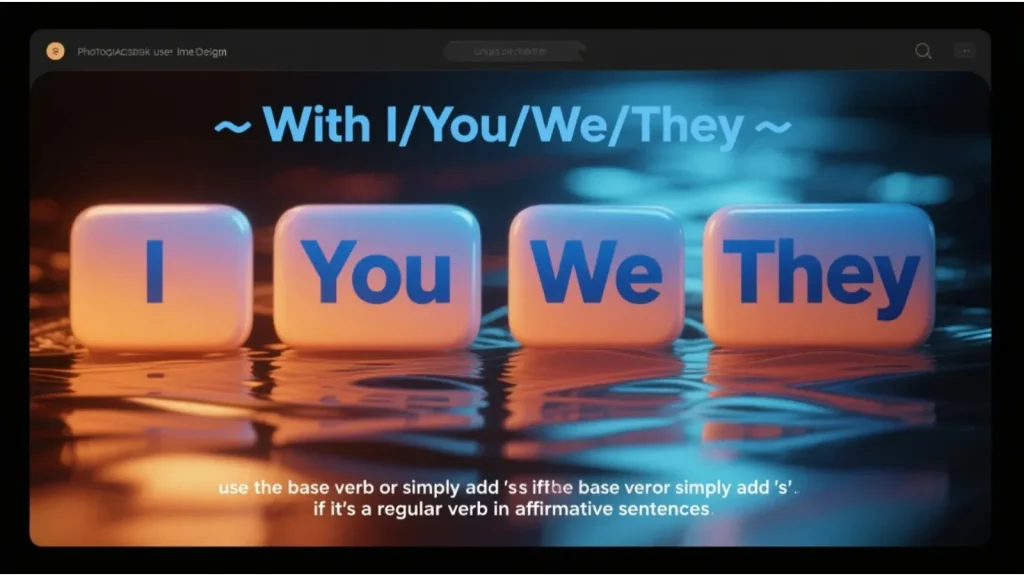
Trong thì hiện tại đơn, với các chủ ngữ I, You, We, They hoặc danh từ số nhiều, động từ thường luôn ở dạng nguyên thể, không thêm “s/es” ở câu khẳng định. Quy tắc này khác hoàn toàn với He/She/It, giúp câu văn đơn giản và dễ nhớ hơn rất nhiều. Ví dụ: “I play football”, “They go to school”, “We like music” đều dùng động từ gốc.
Nhiều người học tưởng rằng chỉ có He/She/It mới thêm “s”, còn lại thì không bao giờ thêm. Thực tế đúng là như vậy ở câu khẳng định. “You watch TV”, “Children run fast”, “My friends live nearby” – không một trường hợp nào cần thêm “s” dù động từ có tận cùng ch, sh, o, x, z. Quy tắc này áp dụng đồng nhất cho mọi động từ thường.
Tuy nhiên, vẫn có một số người nhầm lẫn khi viết, đặc biệt khi chủ ngữ là danh từ số nhiều trông giống số ít. Ví dụ, sai lầm phổ biến là “The police catches thieves” (sai), phải là “The police catch thieves” vì “police” là danh từ số nhiều. Tương tự, “people” luôn đi với động từ nguyên thể: “People need love”.
Trong văn nói và viết thân mật, người bản xứ thường dùng dạng rút gọn với trợ động từ ở câu phủ định hoặc nghi vấn, nhưng ở câu khẳng định thì không có hiện tượng rút gọn động từ chính. Vì thế, “We don’t like”, “Do they play?” vẫn giữ nguyên dạng gốc của động từ chính khi chuyển sang phủ định hay nghi vấn.
Quy tắc này làm cho thì hiện tại đơn trở nên dễ học hơn đối với người mới bắt đầu. Chỉ cần nhớ: nếu chủ ngữ không phải He/She/It/danh từ số ít thì cứ yên tâm dùng động từ nguyên thể ở câu khẳng định. Không cần lo lắng về việc thêm “s”, “es”, hay đổi “y” thành “ies” như ngôi thứ ba.
Việc nắm chắc quy tắc này giúp người học tự tin hơn khi viết đoạn văn hoặc nói chuyện hàng ngày. Dù chủ ngữ là I, You, We, They hay bất kỳ danh từ số nhiều nào, chỉ một nguyên tắc duy nhất: giữ nguyên động từ, không thêm gì cả. Nhờ đó, câu văn luôn đúng và nghe rất tự nhiên.
| Thì hiện tại đơn, chủ ngữ I/You/We/They hoặc danh từ số nhiều: động từ thường luôn ở dạng nguyên thể, không thêm “s/es” ở câu khẳng định. Ví dụ: I go, You play, We study, They watch. Quy tắc này áp dụng đồng nhất, không có ngoại lệ, giúp câu văn đơn giản và dễ nhớ. |
Bài tập
- I _____ (like) chocolate very much.
- You _____ (speak) English very well.
- I _____ (go) to bed at 11 p.m. every night.
- You _____ (play) mobile games every day.
- I _____ (drink) two cups of coffee every morning.
- You _____ (watch) Netflix on weekends.
- I _____ (study) English three hours a day.
- You _____ (live) near my house.
- I _____ (walk) to school every morning.
- You _____ (need) help with this exercise.
- I _____ (listen) to music while cooking.
- You _____ (have) breakfast at 7 a.m.
- I _____ (read) books in English now.
- You _____ (drive) very carefully.
- I _____ (cook) dinner for my family on Sunday.
- You _____ (visit) your grandparents every week.
- I _____ (work) as a designer.
- You _____ (swim) very well.
- I _____ (wake) up early on weekdays.
- You _____ (call) me every evening.
- We _____ (play) football after school.
- They _____ (live) in Ho Chi Minh City.
- My friends _____ (like) Korean music.
- We _____ (go) jogging every morning.
- The children _____ (run) very fast.
- They _____ (study) at Ton Duc Thang University.
- Our teachers _____ (speak) English fluently.
- We _____ (watch) movies on Friday nights.
- People _____ (need) love and respect.
- The police _____ (work) very hard.
- My parents _____ (travel) by plane.
- We _____ (eat) rice every day.
- They _____ (do) their homework carefully.
- Cats _____ (sleep) a lot during the day.
- My classmates _____ (play) basketball at break time.
- We _____ (visit) our grandparents every Sunday.
- Dogs _____ (bark) at strangers.
- They _____ (have) two cars.
- Students _____ (wear) uniforms to school.
- We _____ (listen) to the teacher in class.
- The buses _____ (come) every 10 minutes.
- They _____ (speak) three languages.
- My brothers _____ (play) video games all day.
- We _____ (drink) green tea after meals.
- Children _____ (love) cartoons.
- They _____ (fly) kites in the park.
- Our neighbors _____ (make) a lot of noise.
- We _____ (clean) the house every Saturday.
- Birds _____ (sing) in the morning.
- My sisters _____ (dance) very well.
- We _____ (study) English and _____ (listen) to BBC every day.
- They _____ (play) games and _____ (chat) online at night.
- You _____ (wake) up early and _____ (do) exercise.
- My friends _____ (go) to the cinema and _____ (eat) popcorn.
- We _____ (have) dinner and _____ (watch) TV together.
- The children _____ (run) in the park and _____ (laugh) loudly.
- They _____ (travel) by train and _____ (read) books.
- I _____ (cook) phở and _____ (invite) friends on Sunday.
- You _____ (work) hard and _____ (earn) a lot of money.
- We _____ (visit) museums and _____ (take) photos.
- My parents _____ (drink) coffee and _____ (read) newspapers every morning.
- They _____ (play) music and _____ (sing) very loudly.
- The students _____ (ask) questions and _____ (write) notes.
- We _____ (walk) to school and _____ (talk) about homework.
- Dogs _____ (chase) cats and _____ (bark) all day.
- I _____ (brush) my teeth and _____ (wash) my face twice a day.
- You _____ (call) me and _____ (tell) funny stories.
- They _____ (buy) clothes and _____ (try) them on.
- We _____ (finish) work early and _____ (go) home by bus.
- Children _____ (draw) pictures and _____ (color) them beautifully.
- People _____ (use) smartphones every day.
- The police _____ (catch) thieves quickly.
- Fish _____ (swim) in the water.
- Sheep _____ (eat) grass in the field.
- People _____ (believe) in true love.
- The police _____ (protect) our city.
- Children _____ (need) care and education.
- Deer _____ (run) very fast in the forest.
- People _____ (make) mistakes sometimes.
- The police _____ (wear) uniforms.
- Fish _____ (live) in the sea and rivers.
- My family _____ (gather) every Tet holiday.
- People _____ (say) “hello” when they meet.
- The police _____ (help) people in danger.
- Children _____ (cry) when they are hungry.
- We _____ (recycle) plastic bottles every week.
- They _____ (volunteer) at the orphanage every month.
- My classmates _____ (exchange) gifts on Christmas.
- You _____ (deserve) the best things in life.
- We _____ (celebrate) Teachers’ Day on November 20th.
- They _____ (practice) speaking English every night.
- Teenagers _____ (spend) a lot of time on social media.
- We _____ (donate) old clothes to charity.
- My friends _____ (organize) parties every weekend.
- You _____ (inspire) me every day.
- They _____ (discover) new places when they travel.
- We _____ (respect) our parents and teachers.
- Students _____ (prepare) carefully for the final exam.
- My family _____ (support) me in everything I do.
- We all _____ (dream) of a better future.
Đáp án:
1–100: dùng chính động từ trong ngoặc (không thêm gì cả)
Thông thường chỉ thêm -s: play → plays, want → wants

Khi học thì hiện tại đơn với chủ ngữ ngôi thứ ba số ít, quy tắc đơn giản và phổ biến nhất chính là chỉ thêm “-s” vào cuối động từ. Hầu hết các động từ thông dụng đều tuân theo cách này mà không cần biến đổi gì thêm. Chẳng hạn, play → plays, want → wants, like → likes, help → helps, start → starts, call → calls. Người học chỉ cần nhìn động từ gốc là có thể áp dụng ngay lập tức.
Quy tắc này áp dụng cho mọi động từ không thuộc các nhóm đặc biệt như kết thúc bằng o, s, x, z, ch, sh hoặc phụ âm + y. Ví dụ, “She opens the window every morning”, “He reads books in the evening”, “My cat sleeps all day”. Cả ba câu đều chỉ thêm “-s” một cách tự nhiên, không cần suy nghĩ nhiều.
Về mặt phát âm, đuôi “-s” có hai cách đọc chính. Nếu âm cuối của động từ là âm vô thanh (p, t, k, f), ta đọc /s/: stops /stɒps/, walks /wɔːks/, laughs /lɑːfs/. Ngược lại, nếu âm cuối là âm hữu thanh hoặc nguyên âm, ta đọc /z/: plays /pleɪz/, lives /lɪvz/, needs /niːdz/. Việc luyện phát âm đúng giúp câu nói nghe giống người bản xứ hơn.
Trong thực tế, hàng nghìn động từ tiếng Anh thuộc nhóm chỉ thêm “-s” này. Người học không cần ghi nhớ từng từ một, chỉ cần xác định động từ không rơi vào các trường hợp ngoại lệ là yên tâm thêm “-s”. Nhờ vậy, việc viết và nói trở nên nhanh chóng và ít sai sót hơn.
Nắm chắc quy tắc “thông thường chỉ thêm -s” là nền tảng quan trọng để làm chủ thì hiện tại đơn. Khi gặp động từ quen thuộc như listen → listens, watch → watches (không phải nhóm ch/sh), rain → rains, cook → cooks, mọi thứ đều trở nên dễ dàng. Chỉ một chữ “s” nhỏ nhưng giúp cả câu đúng ngữ pháp và nghe rất tự nhiên.
| Quy tắc cơ bản nhất khi chia động từ thì hiện tại đơn với He/She/It: chỉ thêm “-s” (play → plays, want → wants, like → likes, help → helps). Áp dụng cho mọi động từ không kết thúc bằng o, s, x, z, ch, sh hay phụ âm+y. Đây là cách phổ biến, đơn giản và chiếm đa số trong tiếng Anh hàng ngày. |
- She _____ (like) chocolate ice-cream very much.
- He _____ (play) football after school.
- My father _____ (read) the newspaper every morning.
- Lan _____ (walk) to school with her friends.
- The dog _____ (sleep) on the sofa all day.
- Tom _____ (help) his mother with housework.
- She _____ (listen) to music while studying.
- He _____ (call) his girlfriend every night.
- The sun _____ (rise) in the east.
- My sister _____ (paint) beautiful pictures.
- He _____ (start) work at 8 a.m. sharp.
- She _____ (open) the shop at 7 o’clock.
- The baby _____ (smile) when he sees me.
- Minh _____ (clean) his room every Saturday.
- She _____ (dream) about traveling the world.
- He _____ (cook) dinner for the family.
- The teacher _____ (explain) the lesson very clearly.
- Lan _____ (need) a new phone.
- My brother _____ (collect) old coins.
- She _____ (talk) to her friends on the phone.
- He _____ (work) as an engineer.
- The cat _____ (jump) on the table.
- Tom _____ (visit) his grandparents every Sunday.
- She _____ (love) romantic movies.
- He _____ (learn) English on Duolingo.
- My mother _____ (drink) green tea every afternoon.
- He _____ (live) near the train station.
- The moon _____ (appear) at night.
- She _____ (stay) at home on Sunday.
- Lan _____ (sing) very well.
- He _____ (plan) his day carefully.
- The wind _____ (blow) strongly in March.
- She _____ (answer) all the questions correctly.
- Tom _____ (follow) a healthy diet.
- He _____ (turn) off the lights before sleeping.
- My father _____ (drive) to work every day.
- She _____ (smile) a lot when she’s happy.
- The river _____ (flow) to the sea.
- He _____ (remember) people’s birthdays.
- Lan _____ (believe) in true love.
- The phone _____ (ring) many times a day.
- She _____ (change) her hairstyle every month.
- He _____ (accept) the new job offer.
- My sister _____ (draw) cartoons very well.
- Tom _____ (return) home at 6 p.m.
- She _____ (prepare) lessons in the evening.
- He _____ (rain) the flowers every morning.
- The baby _____ (laugh) when I play with him.
- Lan _____ (enjoy) reading novels.
- He _____ (rest) after a long day.
- She _____ (type) very fast.
- He _____ (knock) on the door before entering.
- My brother _____ (lift) weights at the gym.
- The teacher _____ (correct) our homework.
- She _____ (save) money for a new laptop.
- He _____ (kick) the ball hard.
- Lan _____ (join) the English club this year.
- The shop _____ (close) at 10 p.m.
- He _____ (repeat) the words many times.
- She _____ (travel) by motorbike.
- Tom _____ (shout) when he’s excited.
- The train _____ (stop) at this station.
- She _____ (hug) her friends when they meet.
- He _____ (move) to a new apartment.
- My mother _____ (bake) cakes on weekends.
- The student _____ (raise) his hand to ask questions.
- She _____ (check) her email every hour.
- He _____ (pull) the door gently.
- Lan _____ (post) photos on Instagram.
- The boy _____ (wave) goodbye to his parents.
- She _____ (text) her friends all day.
- He _____ (touch) the screen to unlock the phone.
- My sister _____ (film) videos for TikTok.
- The car _____ (park) in front of the house.
- He _____ (point) at the board.
- She _____ (wake) up early and _____ (exercise) every day.
- He _____ (study) hard and _____ (dream) of a good university.
- Lan _____ (love) animals and _____ (feed) street cats.
- Tom _____ (work) late and _____ (sleep) only 5 hours.
- The teacher _____ (speak) slowly and _____ (repeat) important words.
- She _____ (smile) a lot and _____ (make) everyone happy.
- He _____ (play) the guitar and _____ (sing) beautifully.
- My father _____ (read) books and _____ (drink) tea in the evening.
- The baby _____ (cry) sometimes but usually _____ (smile).
- Lan _____ (learn) new words and _____ (use) them every day.
- He _____ (run) every morning and _____ (feel) very healthy.
- She _____ (paint) pictures and _____ (sell) them online.
- Tom _____ (help) his friends and _____ (share) his notes.
- The dog _____ (follow) me and _____ (wait) for food.
- My mother _____ (cook) delicious food and _____ (invite) guests.
- He _____ (watch) documentaries and _____ (learn) many things.
- She _____ (dance) gracefully and _____ (win) many competitions.
- Lan _____ (practice) speaking and _____ (improve) quickly.
- The boy _____ (jump) high and _____ (touch) the basketball ring.
- He _____ (listen) carefully and _____ (understand) everything.
- She _____ (design) clothes and _____ (open) her own shop.
- Tom _____ (train) hard and _____ (become) stronger every day.
- My sister _____ (write) poems and _____ (read) them to us.
- He _____ (repair) things and _____ (save) a lot of money.
- Lan _____ (believe) in herself and _____ (achieve) all her goals.
Đáp án
- likes
- plays
- reads
- walks
- sleeps
- helps
- listens
- calls
- rises
- paints
- starts
- opens
- smiles
- cleans
- dreams
- cooks
- explains
- needs
- collects
- talks
- works
- jumps
- visits
- loves
- learns
- drinks
- lives
- appears
- stays
- sings
- plans
- blows
- answers
- follows
- turns
- drives
- smiles
- flows
- remembers
- believes
- rings
- changes
- accepts
- draws
- returns
- prepares
- waters
- laughs
- enjoys
- rests
- types
- knocks
- lifts
- corrects
- saves
- kicks
- joins
- closes
- repeats
- travels
- shouts
- stops
- hugs
- moves
- bakes
- raises
- checks
- pulls
- posts
- waves
- texts
- touches
- films
- parks
- points
- wakes – exercises
- studies – dreams
- loves – feeds
- works – sleeps
- speaks – repeats
- smiles – makes
- plays – sings
- reads – drinks
- cries – smiles
- learns – uses
- runs – feels
- paints – sells
- helps – shares
- follows – waits
- cooks – invites
- watches – learns
- dances – wins
- practices – improves
- jumps – touches
- listens – understands
- designs – opens
- trains – becomes
- writes – reads
- repairs – saves
- believes – achieves
Kết thúc bằng s, sh, ch, x, z, o → thêm -es: watch → watches, go → goes, kiss → kisses

Khi động từ kết thúc bằng các chữ cái s, sh, ch, x, z hoặc o, ta không chỉ thêm “s” mà phải thêm “-es” ở thì hiện tại đơn với chủ ngữ He/She/It. Quy tắc này giúp tránh việc phát âm khó khi hai âm cản nhau. Ví dụ phổ biến: watch → watches, wash → washes, go → goes, do → does, kiss → kisses, fix → fixes.
Những động từ quen thuộc trong đời sống hàng ngày hầu hết thuộc nhóm này. Chẳng hạn: “She watches TV every evening”, “He goes to bed early”, “My mother washes clothes on Sunday”, “The bus passes my house at 7 a.m.”. Nếu chỉ thêm “s” thông thường, câu sẽ vừa sai ngữ pháp vừa nghe kém tự nhiên.
Về phát âm, đuôi “-es” sau các âm trên luôn được đọc là /ɪz/. Điều này rất dễ nhận biết: watches /ˈwɒtʃɪz/, goes /ɡəʊz/, fixes /ˈfɪksɪz/, kisses /ˈkɪsɪz/. Người học Việt Nam thường quên đọc âm /ɪ/ ở giữa, nên hay nói sai thành /wɒtʃz/ hoặc /ɡəʊz/ không rõ ràng. Luyện nói chậm và nghe nhiều sẽ giúp khắc phục nhanh.
Một số người mới học hay nhầm lẫn viết “watchs” hoặc “goies”. Cần nhớ thật kỹ: chỉ có năm nhóm âm cuối này mới thêm “-es”, các trường hợp khác chỉ thêm “-s” bình thường. Đặc biệt, động từ “do” và “go” rất hay xuất hiện nên phải ghi nhớ: He does his homework, She goes jogging every morning.
Trong thực tế, nhóm động từ này không quá nhiều nhưng lại rất thông dụng. Chỉ cần nắm chắc danh sách s-sh-ch-x-z-o là có thể áp dụng ngay mà không cần tra từ điển. Nhờ đó, việc viết và nói câu khẳng định ngôi thứ ba trở nên chính xác và tự nhiên hơn rất nhiều.
Quy tắc thêm “-es” tuy nhỏ nhưng quan trọng để tránh lỗi sai cơ bản. Khi gặp bất kỳ động từ nào có đuôi thuộc năm nhóm trên, người học chỉ cần thêm “-es” và đọc /ɪz/ là xong. Luyện tập thường xuyên sẽ biến quy tắc này thành phản xạ tự nhiên.
| Động từ kết thúc bằng s, sh, ch, x, z, o → thêm “-es” (không chỉ “-s”): watch → watches, wash → washes, go → goes, do → does, kiss → kisses, fix → fixes. Phát âm đuôi “-es” luôn là /ɪz/. Quy tắc này áp dụng bắt buộc với He/She/It ở thì hiện tại đơn để câu đúng ngữ pháp và dễ phát âm. |
Bài tập
- She _____ (watch) Korean dramas every night.
- He _____ (go) to school by bus.
- My mother _____ (wash) the dishes after dinner.
- The bus _____ (pass) my house at 7:30.
- Lan _____ (do) her homework carefully.
- He _____ (brush) his teeth three times a day.
- She _____ (teach) English at primary school.
- The dog _____ (chase) cats in the garden.
- Tom _____ (fix) everything in the house.
- She _____ (kiss) her children goodnight.
- He _____ (catch) the train at 6 a.m.
- The baby _____ (cry) when she is hungry.
- Lan _____ (finish) work at 5 p.m.
- He _____ (push) the door gently.
- She _____ (reach) the office before 8 o’clock.
- My father _____ (mix) coffee with milk.
- The chef _____ (dish) the food beautifully.
- He _____ (relax) after a long day.
- She _____ (guess) the answer correctly.
- The machine _____ (buzz) when it’s ready.
- Tom _____ (cross) the street carefully.
- She _____ (miss) her family when she travels.
- He _____ (fish) at the lake every weekend.
- Lan _____ (box) three times a week.
- The kettle _____ (whistle) when the water boils.
- He _____ (go) jogging every morning.
- She _____ (watch) YouTube before sleeping.
- My sister _____ (wash) her hair every day.
- The train _____ (pass) this station twice a day.
- Tom _____ (do) the laundry on Monday.
- She _____ (brush) her long hair 100 times.
- He _____ (teach) Math at high school.
- The cat _____ (scratch) the sofa.
- Lan _____ (fix) her bike herself.
- He _____ (kiss) his wife every morning.
- She _____ (catch) butterflies in the park.
- The baby _____ (laugh) at funny faces.
- He _____ (finish) his meal quickly.
- My mother _____ (wash) clothes by hand.
- The boy _____ (push) his friend playfully.
- She _____ (reach) high scores in every exam.
- He _____ (mix) colors like a real artist.
- Lan _____ (rush) to school every morning.
- The clock _____ (tick) loudly in the room.
- She _____ (blush) when someone compliments her.
- He _____ (march) in the school parade.
- Tom _____ (search) for information online.
- She _____ (touch) the screen to unlock her phone.
- The wind _____ (lash) the trees during the storm.
- He _____ (crash) his bike into the wall yesterday (no → present habit: often).
- She always _____ (watch) the news at 8 p.m.
- He _____ (go) to bed at 10 p.m. sharp.
- Lan _____ (do) yoga every morning.
- The dog _____ (chase) its tail all day.
- My brother _____ (fix) computers for friends.
- She _____ (wash) fruits before eating.
- He _____ (teach) piano on weekends.
- The baby _____ (clutch) his toy tightly.
- Tom _____ (catch) the ball perfectly.
- She _____ (brush) the dog every evening.
- He _____ (push) himself to study harder.
- The chef _____ (slice) and _____ (dice) vegetables quickly.
- Lan _____ (finish) her projects before deadline.
- My father _____ (relax) and _____ (fish) on Sunday.
- She _____ (miss) the bus almost every day.
- He _____ (cross) the road at the zebra crossing.
- The girl _____ (wish) on stars every night.
- Tom _____ (pitch) the ball very well.
- She _____ (sketch) portraits beautifully.
- The phone _____ (buzz) with notifications.
- He _____ (dash) to catch the early train.
- Lan _____ (stash) money in her piggy bank.
- The cat _____ (stretch) after sleeping.
- She _____ (crush) garlic for cooking.
- He _____ (flash) a big smile when happy.
- She _____ (watch) TV and _____ (eat) snacks in the evening.
- He _____ (go) to work early and _____ (return) home late.
- Lan _____ (do) housework and _____ (cook) dinner every day.
- The dog _____ (chase) birds and _____ (dig) holes in the garden.
- Tom _____ (fix) things and _____ (save) a lot of money.
- She _____ (wash) clothes and _____ (hang) them outside.
- He _____ (teach) students and _____ (check) homework every night.
- The baby _____ (cry) loudly but _____ (calm) down quickly.
- My mother _____ (wash) dishes and _____ (sing) old songs.
- Lan _____ (finish) work and _____ (relax) with a book.
- He _____ (catch) fish and _____ (release) small ones.
- She _____ (brush) her hair and _____ (smile) at the mirror.
- The boy _____ (push) the swing and _____ (laugh) happily.
- Tom _____ (mix) paint and _____ (create) beautiful pictures.
- The wind _____ (lash) rain against the windows.
- She _____ (watch) the stars and _____ (wish) for happiness.
- He _____ (go) running and _____ (listen) to music.
- Lan _____ (teach) children and _____ (love) her job.
- The cat _____ (stretch) lazily and _____ (yawn).
- My father _____ (fix) the car and _____ (wash) it every week.
- She _____ (kiss) the baby and _____ (sing) lullabies.
- He _____ (catch) the bus and _____ (read) news on his phone.
- The chef _____ (slice), _____ (dice), and _____ (mix) everything perfectly.
- Lan _____ (rush) to class but never _____ (miss) the lesson.
- Tom _____ (watch) tutorials and _____ (practice) new skills every day.
Đáp án (luôn thêm -es, phát âm /ɪz/):
- watches
- goes
- washes
- passes
- does
- brushes
- teaches
- chases
- fixes
- kisses
- catches
- cries
- finishes
- pushes
- reaches
- mixes
- dishes
- relaxes
- guesses
- buzzes
- crosses
- misses
- fishes
- boxes
- whistles
- goes
- watches
- washes
- passes
- does
- brushes
- teaches
- scratches
- fixes
- kisses
- catches
- laughs
- finishes
- washes
- pushes
- reaches
- mixes
- rushes
- ticks
- blushes
- marches
- searches
- touches
- lashes
- crashes
- watches
- goes
- does
- chases
- fixes
- washes
- teaches
- clutches
- catches
- brushes
- pushes
- slices – dices
- finishes
- relaxes – fishes
- misses
- crosses
- wishes
- pitches
- sketches
- buzzes
- dashes
- stashes
- stretches
- crushes
- flashes
- watches – eats
- goes – returns
- does – cooks
- chases – digs
- fixes – saves
- washes – hangs
- teaches – checks
- cries – calms
- washes – sings
- finishes – relaxes
- catches – releases
- brushes – smiles
- pushes – laughs
- mixes – creates
- lashes
- watches – wishes
- goes – listens
- teaches – loves
- stretches – yawns
- fixes – washes
- kisses – sings
- catches – reads
- slices – dices – mixes
- rushes – misses
- watches – practices
Phụ âm + y → đổi y thành i + es: study → studies, fly → flies

Khi động từ kết thúc bằng một phụ âm + y, ta phải đổi “y” thành “i” rồi thêm “es” ở thì hiện tại đơn với chủ ngữ ngôi thứ ba số ít. Quy tắc này rất quen thuộc nhưng cũng dễ gây nhầm lẫn nếu không chú ý. Ví dụ: study → studies, cry → cries, fly → flies, try → tries, hurry → hurries. Không bao giờ được viết “studys” hay “flys”.
Cách thay đổi này giúp phát âm mượt mà hơn và đúng chính tả tiếng Anh. Chẳng hạn, “She studies English every night”, “The baby cries when he is hungry”, “My brother flies to Hanoi every month”. Nếu giữ nguyên “y” rồi chỉ thêm “s”, câu sẽ sai ngay lập tức và trông rất lạ.
Ngược lại, nếu trước “y” là một nguyên âm (a, e, i, o, u), ta chỉ thêm “s” bình thường, không đổi “y”. Ví dụ: play → plays, stay → stays, buy → buys, enjoy → enjoys. Người học cần phân biệt rõ hai trường hợp này để tránh viết sai.
Nhiều học sinh Việt Nam hay quên bước đổi “y” thành “i”, đặc biệt khi viết nhanh. Lỗi thường gặp là “He trys hard” (sai) thay vì “He tries hard”, hoặc “The bird flys” thay vì “The bird flies”. Chỉ cần nhớ một mẹo nhỏ: thấy phụ âm đứng trước “y” thì đổi thành “i” trước khi thêm “es”.
Trong giao tiếp hàng ngày, nhóm động từ này xuất hiện rất nhiều: study, carry, worry, reply, apply… Vì vậy, nắm chắc quy tắc sẽ giúp viết và nói tự nhiên hơn. Phát âm cũng dễ: studies /ˈstʌdiz/, cries /kraɪz/, flies /flaɪz/ – đều đọc /z/ ở cuối.
Chỉ cần luyện tập vài lần, việc đổi “y” thành “i” + “es” sẽ trở thành thói quen. Đây là một trong những quy tắc nhỏ nhưng quan trọng để làm chủ hoàn toàn thì hiện tại đơn ở ngôi thứ ba.
Bài tập
- She _____ (study) English three hours every night.
- The baby _____ (cry) when he is hungry.
- He _____ (fly) to Singapore every month.
- Lan _____ (try) to speak English every day.
- My brother _____ (hurry) to school every morning.
- She _____ (carry) a heavy bag to class.
- The dog _____ (bury) bones in the garden.
- He _____ (worry) about the exam results.
- My sister _____ (copy) the notes carefully.
- Tom _____ (reply) to emails very quickly.
- The child _____ (cry) during sad movies.
- She _____ (study) Math until midnight.
- He _____ (deny) everything at first.
- Lan _____ (apply) for a new job.
- The boy _____ (dry) the dishes after dinner.
- She _____ (fry) fish for lunch.
- My father _____ (worry) when I come home late.
- The cat _____ (spy) on the birds all day.
- He _____ (marry) his girlfriend last year (habit: still talks about it → present).
- She _____ (rely) on her best friend.
- Tom _____ (supply) fresh vegetables every day.
- The baby _____ (try) to walk every day.
- Lan _____ (multiply) big numbers very fast.
- He _____ (carry) water for his mother.
- She _____ (envy) her sister’s new phone.
- My little brother _____ (cry) for candy.
- He _____ (fly) kites on Sunday.
- She _____ (hurry) but always forgets something.
- The teacher _____ (clarify) difficult points.
- Lan _____ (study) abroad next year (but she already prepares → present habit).
- He _____ (worry) too much about small things.
- The baby _____ (cry) at night sometimes.
- She _____ (try) new recipes every week.
- My mother _____ (fry) spring rolls on weekends.
- Tom _____ (carry) his little sister on his back.
- He _____ (deny) eating the cake.
- She _____ (reply) to messages immediately.
- The bird _____ (fly) south in winter.
- Lan _____ (copy) songs from YouTube.
- He _____ (hurry) to catch the bus.
- The dog _____ (bury) toys in the yard.
- She _____ (apply) makeup before going out.
- My brother _____ (spy) on the neighbors.
- The boy _____ (dry) his hair with a towel.
- She _____ (worry) about her test score.
- He _____ (study) until 1 a.m. every day.
- Lan _____ (cry) only in sad movies.
- The plane _____ (fly) over our house twice a day.
- She _____ (try) to save money.
- He _____ (carry) groceries for old people.
- She _____ (study) and _____ (listen) to music at the same time.
- He _____ (hurry) home and _____ (do) his homework.
- Lan _____ (cry) easily but _____ (smile) again quickly.
- The baby _____ (try) to talk and _____ (copy) adults.
- My father _____ (worry) about money and _____ (work) extra hours.
- She _____ (fly) to Hanoi and _____ (visit) her family every month.
- Tom _____ (carry) books and _____ (help) his friends.
- He _____ (deny) the mistake but finally _____ (admit) it.
- The teacher _____ (clarify) grammar and _____ (give) examples.
- She _____ (fry) chicken and _____ (make) salad every Sunday.
- Lan _____ (apply) for scholarships and _____ (study) hard.
- The boy _____ (spy) on his sister and _____ (laugh).
- My mother _____ (worry) when I _____ (stay) out late.
- He _____ (hurry) to work but never _____ (complain).
- The dog _____ (bury) food and _____ (dig) it up later.
- She _____ (reply) to letters and _____ (write) beautifully.
- Tom _____ (try) new sports and _____ (enjoy) them all.
- The baby _____ (cry) for milk and _____ (stop) immediately after drinking.
- Lan _____ (study) French and _____ (practice) every evening.
- He _____ (carry) water and _____ (water) the plants.
- She _____ (worry) about the future and _____ (plan) carefully.
- The bird _____ (fly) high and _____ (sing) beautifully.
- My brother _____ (copy) my homework and _____ (get) caught.
- She _____ (dry) clothes outside and _____ (bring) them in at night.
- He _____ (fry) eggs and _____ (make) sandwiches for breakfast.
- Lan always _____ (try) her best in every exam.
- He _____ (study) medicine and _____ (dream) of becoming a doctor.
- The little girl _____ (cry) when she _____ (lose) her toy.
- My sister _____ (hurry) to school but never _____ (miss) the bus.
- She _____ (carry) responsibility for the whole family.
- Tom _____ (worry) about climate change and _____ (recycle) everything.
- The plane _____ (fly) over the city and _____ (make) loud noise.
- Lan _____ (apply) the rules and _____ (expect) everyone to follow.
- He _____ (deny) being tired but _____ (sleep) very early.
- She _____ (fry) tofu and _____ (cook) healthy meals every day.
- The baby _____ (try) new food and sometimes _____ (cry).
- My father _____ (worry) about my health and _____ (cook) nutritious food.
- She _____ (study) late and _____ (wake) up early anyway.
- The boy _____ (hurry) home and _____ (play) games all evening.
- Lan _____ (copy) famous paintings and _____ (sell) them online.
- He _____ (carry) dreams and _____ (work) hard to achieve them.
- The teacher _____ (clarify) everything and never _____ (get) angry.
- She _____ (cry) during movies but _____ (say) she’s fine.
- My brother _____ (fly) drones and _____ (film) beautiful videos.
- Tom _____ (worry) too much and _____ (forget) to enjoy life.
- The cat _____ (spy) on birds and suddenly _____ (jump).
- She _____ (study) abroad and _____ (miss) Vietnamese food.
- He _____ (try) to quit coffee but always _____ (fail).
- Lan _____ (hurry) through breakfast and _____ (run) to school.
- The little prince _____ (cry) when he _____ (feel) lonely.
Đáp án đầy đủ 100 câu – Nhóm phụ âm + y → đổi thành “ies”
- studies
- cries
- flies
- tries
- hurries
- carries
- buries
- worries
- copies
- replies
- cries
- studies
- denies
- applies
- dries
- fries
- worries
- spies
- marries
- relies
- supplies
- tries
- multiplies
- carries
- envies
- cries
- flies
- hurries
- clarifies
- studies
- worries
- cries
- tries
- fries
- carries
- denies
- replies
- flies
- copies
- hurries
- buries
- applies
- spies
- dries
- worries
- studies
- cries
- flies
- tries
- carries
- studies – listens
- hurries – does
- cries – smiles
- tries – copies
- worries – works
- flies – visits
- carries – helps
- denies – admits
- clarifies – gives
- fries – makes
- applies – studies
- spies – laughs
- worries – stay
- hurries – complains
- buries – digs
- replies – writes
- tries – enjoys
- cries – stops
- studies – practices
- carries – waters
- worries – plans
- flies – sings
- copies – gets
- dries – brings
- fries – makes
- tries
- studies – dreams
- cries – loses
- hurries – misses
- carries
- worries – recycles
- flies – makes
- applies – expects
- denies – sleeps
- fries – cooks
- tries – cries
- worries – cooks
- studies – wakes
- hurries – plays
- copies – sells
- carries – works
- clarifies – gets
- cries – says
- flies – films
- worries – forgets
- spies – jumps
- studies – misses
- tries – fails
- hurries – runs
- cries – feels
| Động từ kết thúc bằng phụ âm + y → đổi y thành i rồi thêm es: study → studies, cry → cries, fly → flies, try → tries. Không được giữ y + s. Nếu trước y là nguyên âm thì chỉ thêm s (play → plays). Quy tắc bắt buộc với He/She/It ở thì hiện tại đơn. |
Nguyên âm + y → chỉ thêm s: play → plays, buy → buys
Khi động từ kết thúc bằng nguyên âm + y, ta chỉ thêm “s” bình thường, không đổi “y” thành “i”. Đây là quy tắc đơn giản và khác hoàn toàn với trường hợp phụ âm + y. Ví dụ điển hình: play → plays, stay → stays, buy → buys, enjoy → enjoys, pray → prays. Người học chỉ cần nhìn chữ cái đứng trước “y” là áp dụng ngay.
Nhiều người mới học hay nhầm lẫn và đổi “y” thành “i” trong mọi trường hợp. Viết “plaies” hay “buys” thành “buies” đều sai hoàn toàn. Đúng phải là “He plays football very well”, “She buys new clothes every month”, “The dog always stays at home”. Nhớ kỹ: có a, e, i, o, u đứng trước “y” thì giữ nguyên “y”.
Phát âm của các động từ này cũng rất dễ. Đuôi “-s” được đọc /z/ vì trước nó là nguyên âm: plays /pleɪz/, buys /baɪz/, enjoys /ɪnˈdʒɔɪz/. Âm cuối nghe tự nhiên, mượt mà, không cần thêm âm /ɪ/ như nhóm “-es”. Người Việt thường phát âm đúng nhóm này ngay từ lần đầu.
Trong thực tế, nhóm động từ nguyên âm + y rất phổ biến trong giao tiếp hàng ngày. Chúng ta thường xuyên gặp play, stay, say, pay, lay, display, delay… Vì vậy, nắm chắc quy tắc chỉ thêm “s” giúp viết và nói nhanh mà không cần suy nghĩ. Chỉ cần nhìn một chữ cái trước “y” là đủ để quyết định cách chia.
Đây là một trong những quy tắc dễ nhớ nhất khi học thì hiện tại đơn ngôi thứ ba. Không đổi “y”, không thêm “es”, chỉ thêm “s” đơn giản. Nhờ đó, người học tránh được lỗi sai không đáng có và tự tin hơn khi sử dụng các động từ quen thuộc.
Bài tập
100 câu bài tập chia động từ – Nhóm nguyên âm + y → chỉ thêm “s” (không đổi y) (Chủ ngữ He/She/It hoặc danh từ số ít)
- He _____ (play) football like a professional.
- She _____ (stay) at home on rainy days.
- My brother _____ (buy) a new phone every year.
- Lan _____ (enjoy) listening to K-pop.
- The monkey _____ (play) with the ball all day.
- He _____ (say) “thank you” in English.
- She _____ (pay) the bills online.
- Tom _____ (pray) every night before sleeping.
- The little girl _____ (lay) flowers on the table.
- He _____ (display) his medals on the wall.
- She _____ (delay) her homework until the last minute.
- My mother _____ (spray) perfume every morning.
- Lan _____ (annoy) her brother on purpose.
- He _____ (convey) his ideas clearly.
- The teacher _____ (survey) the class every month.
- She _____ (employ) two helpers at the shop.
- Tom _____ (obey) all the school rules.
- The dog _____ (destroy) shoes when he’s angry.
- She _____ (play) the piano beautifully.
- He _____ (stay) calm in difficult situations.
- Lan _____ (buy) fresh fruit every morning.
- My sister _____ (enjoy) romantic comedies.
- He _____ (say) funny jokes all the time.
- She _____ (pay) attention in class.
- The boy _____ (pray) for good grades.
- He _____ (play) video games after dinner.
- She _____ (stay) up late on weekends.
- Tom _____ (buy) gifts for his girlfriend.
- Lan _____ (enjoy) drawing portraits.
- The baby _____ (play) with toys all morning.
- He _____ (say) “I love you” every day.
- She _____ (pay) by credit card.
- My father _____ (lay) the table before meals.
- The artist _____ (display) paintings in the gallery.
- She _____ (delay) answering messages.
- He _____ (spray) water on the plants.
- Lan _____ (annoy) everyone with her loud music.
- The company _____ (employ) 500 people.
- She _____ (obey) her parents.
- The storm _____ (destroy) many houses.
- He _____ (play) the guitar in the evening.
- She _____ (stay) positive every day.
- Tom _____ (buy) coffee for the team.
- Lan _____ (enjoy) long walks on the beach.
- He _____ (say) hello to everyone.
- She _____ (pay) for dinner last night (habit: always pays).
- The child _____ (pray) before eating.
- My mother _____ (lay) clean sheets every week.
- He _____ (display) good manners.
- She _____ (convey) love through small actions.
- He _____ (play) football and _____ (enjoy) every minute.
- She _____ (stay) home and _____ (read) books all day.
- Lan _____ (buy) clothes and _____ (try) them on immediately.
- Tom _____ (say) jokes and _____ (make) everyone laugh.
- The dog _____ (play) outside and _____ (stay) clean somehow.
- She _____ (pay) bills and _____ (save) the receipts.
- He _____ (pray) quietly and _____ (feel) peaceful.
- My sister _____ (display) photos and _____ (decorate) her room.
- Lan _____ (enjoy) music and _____ (dance) alone.
- He _____ (play) chess and _____ (win) most games.
- She _____ (stay) focused and _____ (finish) work early.
- Tom _____ (buy) snacks and _____ (share) with friends.
- The boy _____ (pray) for rain and _____ (jump) when it comes.
- She _____ (lay) the baby down and _____ (sing) lullabies.
- He _____ (say) the truth and never _____ (lie).
- Lan _____ (enjoy) cooking and _____ (experiment) with new dishes.
- The cat _____ (play) with yarn and _____ (destroy) it quickly.
- She _____ (stay) optimistic and _____ (inspire) others.
- He _____ (buy) flowers and _____ (surprise) his wife.
- My mother _____ (pray) every morning and _____ (smile) all day.
- Tom _____ (play) basketball and _____ (sweat) a lot.
- She _____ (display) confidence and _____ (speak) clearly.
- Lan _____ (enjoy) traveling and _____ (take) beautiful photos.
- He _____ (say) “sorry” and really _____ (mean) it.
- The child _____ (play) happily and _____ (forget) the time.
- She _____ (always play) fair in every game.
- He _____ (stay) loyal to his old friends.
- Lan _____ (buy) only organic vegetables.
- My grandmother _____ (pray) for the whole family.
- The museum _____ (display) ancient artifacts.
- She _____ (enjoy) silence after a noisy day.
- He _____ (play) classical music on the violin.
- Tom _____ (say) wise words at the right time.
- The company _____ (employ) young talented people.
- She _____ (stay) humble despite her success.
- He _____ (buy) books instead of clothes.
- Lan _____ (enjoy) every moment of life.
- The sun _____ (always play) hide-and-seek with clouds.
- My father _____ (lay) bricks perfectly straight.
- She _____ (pray) for peace in the world.
- He _____ (display) amazing dancing skills.
- The little boy _____ (play) alone but happily.
- She _____ (stay) strong through difficult times.
- Tom _____ (buy) coffee for strangers sometimes.
- Lan _____ (enjoy) the little things in life.
- He _____ (say) “good night” with a big smile.
- The shop _____ (display) new items every week.
- She _____ (play) the role of a kind teacher perfectly.
- My mother _____ (pray) and _____ (believe) everything will be okay.
- He _____ (stay) true to himself and _____ (succeed) in the end.
| Động từ kết thúc bằng nguyên âm + y → chỉ thêm “s”, giữ nguyên y: play → plays, stay → stays, buy → buys, enjoy → enjoys. Không đổi y thành i, không thêm es. Quy tắc áp dụng bắt buộc với He/She/It ở thì hiện tại đơn. Phát âm đuôi s là /z/. |
Have → Has (ngoại lệ đặc biệt)

Động từ “have” là một ngoại lệ đặc biệt trong thì hiện tại đơn khi đi với chủ ngữ He/She/It. Thay vì thêm “s” thành “haves” (sai hoàn toàn), ta phải dùng dạng “has”. Ví dụ: “She has long hair”, “My brother has a new phone”, “This car has four doors”. Người học cần ghi nhớ ngay từ đầu vì đây là lỗi rất hay gặp.
Nhiều học sinh Việt Nam quen tư duy quy tắc nên vô thức viết “He haves” hoặc “She haves”. Cả hai đều sai ngữ pháp nghiêm trọng. Chỉ có một cách duy nhất đúng: He/She/It + has. Trong khi đó, I/You/We/They vẫn giữ nguyên “have”: “They have breakfast at 7 a.m.”.
Trong giao tiếp hàng ngày, “has” xuất hiện rất thường xuyên vì “have” mang nhiều nghĩa: sở hữu, ăn uống, trải nghiệm… Ví dụ: “Lan has lunch at school”, “He has a shower every morning”, “The cat has beautiful eyes”. Nếu dùng sai thành “have”, câu sẽ nghe kỳ lạ và không tự nhiên.
Phát âm cũng cần chú ý: “has” mạnh được đọc /hæz/, còn “has” yếu trong câu phủ định và nghi vấn đọc /həz/. Ví dụ: “He has two sisters” (/hæz/), nhưng “He hasn’t any money” (/həznt/). Người học nên luyện nghe để phân biệt hai cách đọc này.
Ở dạng phủ định và nghi vấn, “has” vẫn giữ nguyên dạng đặc biệt này. Ta nói “She has not (hasn’t) time”, “Has he a pen?”. Tuy ngày nay người bản xứ thường dùng “Have you got…?” hoặc “Does he have…?”, nhưng dạng “has” cổ điển vẫn hoàn toàn đúng trong văn viết trang trọng.
Chỉ cần nhớ một điều duy nhất: gặp He/She/It thì “have” luôn biến thành “has”, không theo bất kỳ quy tắc thêm “s/es” nào. Đây là ngoại lệ bắt buộc phải học thuộc để tránh lỗi sai cơ bản khi sử dụng thì hiện tại đơn.
100 câu bài tập chia động từ “have” → “has”
(Chủ ngữ He / She / It hoặc danh từ số ít – 100% phải dùng “has”, không bao giờ thêm “s”)
- She _ long black hair.
- He _ a new motorbike.
- Lan _ two little cats.
- My brother _ breakfast at 6:30 every morning.
- The car _ four doors and a sunroof.
- Tom _ a big collection of stamps.
- This phone _ an excellent camera.
- She _ lunch at school.
- He _ a shower every evening.
- The dog _ a very loud bark.
- My father _ a meeting at 9 a.m.
- Lan _ curly hair.
- The baby _ blue eyes.
- He _ three sisters and one brother.
- This restaurant _ very good phở.
- She _ a lot of homework today.
- Tom _ a red bicycle.
- The house _ a beautiful garden.
- My mother _ a golden necklace.
- He _ dinner with his family every day.
- Lan _ a part-time job at the café.
- The cat _ soft white fur.
- She _ piano lessons on Saturday.
- This bag _ many pockets.
- He _ a cold this week.
- My sister _ a new laptop.
- The teacher _ a red pen in her hand.
- Tom _ swimming practice after school.
- She _ two adorable daughters.
- The movie _ a happy ending.
- He _ an important exam tomorrow.
- Lan _ beautiful long eyelashes.
- This book _ 300 pages.
- My grandfather _ a big farm.
- She _ coffee with milk every morning.
- The room _ air-conditioning.
- He _ a lot of free time on Sunday.
- The little boy _ many toys.
- Lan _ a sweet voice.
- This shirt _ short sleeves.
- Tom _ a dentist appointment today.
- She _ lunch at 12 o’clock.
- The bike _ a basket in front.
- He _ breakfast in the kitchen.
- My phone _ a cracked screen.
- The baby _ a cute smile.
- She _ dance classes twice a week.
- This cake _ chocolate cream.
- He _ a headache after work.
- Lan _ a small tattoo on her wrist.
- She _ long hair and always _ beautiful eyes.
- He _ a car and _ a motorbike too.
- Lan _ two dogs and _ three cats.
- The baby _ blue eyes and _ blond hair.
- Tom _ a bike and _ a skateboard.
- My father _ a big company and _ many employees.
- She _ lunch at school and _ dinner at home.
- The house _ a swimming pool and _ a big garage.
- He _ a shower in the morning and _ another one at night.
- Lan _ English lessons and _ piano lessons.
- This restaurant _ good food and _ excellent service.
- The cat _ green eyes and _ white paws.
- She _ a part-time job and _ many friends.
- Tom _ breakfast early and _ dinner late.
- My phone _ a big screen and _ a strong battery.
- The little girl _ many dolls and _ a teddy bear.
- He _ a cold and _ a cough.
- Lan _ curly hair and _ a bright smile.
- This bag _ many compartments and _ a strong zipper.
- The boy _ a new watch and _ new shoes.
- She _ dance practice and _ singing practice.
- Tom _ two sisters and _ one brother.
- The car _ air-conditioning and _ a sunroof.
- My mother _ a garden and _ many flowers.
- He _ a meeting in the morning and _ another one in the afternoon.
- She _ a kind heart.
- This city _ a lot of tourist attractions.
- Lan _ a dream of studying abroad.
- The story _ a surprising ending.
- He _ confidence in himself.
- My dog _ a favorite toy.
- The hotel _ five stars.
- She _ excellent cooking skills.
- Tom _ a talent for drawing.
- This problem _ a simple solution.
- Lan _ responsibility for the project.
- The baby _ chubby cheeks.
- He _ strong opinions about music.
- The book _ beautiful illustrations.
- She _ faith in her students.
- My father _ great patience.
- This coffee _ a special flavor.
- Lan _ a positive attitude every day.
- The team _ a new captain this year.
- He _ respect for everyone.
- The garden _ colorful flowers all year.
- She _ a lovely singing voice.
- Tom _ a good sense of humor.
- This moment _ special meaning for us.
- Lan _ everything she needs to succeed.
| Động từ “have” là ngoại lệ đặc biệt: với He/She/It → “has” (không phải “haves”). Ví dụ: She has a dog, He has breakfast early, This phone has a good camera. I/You/We/They vẫn dùng “have”. Quy tắc bắt buộc phải nhớ để tránh lỗi sai phổ biến trong thì hiện tại đơn. |
Đọc thêm
- Hiện tại đơn: Tổng hợp tất cả công thức chi tiết, dễ nhớ nhất cho người mới.
- Dấu hiệu nhận biết Hiện tại đơn chuẩn xác 100% không thể nhầm lẫn khi làm bài.
- Nguyên tắc thêm -s/-es sau động từ: Hướng dẫn chi tiết từ A đến Z.
- 100+ Bài tập Hiện tại đơn tự luyện cơ bản có đáp án giải thích.
- Hiện tại đơn dễ hiểu nhất trong 15 phút dành cho người mất gốc tiếng Anh.
- Công thức phủ định Hiện tại đơn và cách dùng Do/Does not đúng chuẩn.
- Cách dùng Hiện tại đơn theo 7 trường hợp chuyên sâu như người bản xứ.
- Thì Hiện tại đơn hại não: 5 trường hợp ngoại lệ ít ai biết.
- Tuyệt chiêu phân biệt Hiện tại đơn và Hiện tại tiếp diễn chỉ trong 5 phút.
- Phân tích chuyên sâu cách dùng Hiện tại đơn mô tả sự kiện cố định.
- Hiện tại đơn khi kể chuyện, tường thuật sự kiện: Hướng dẫn chi tiết.
- Bí mật lỗi sai kinh điển khi dùng Hiện tại đơn và cách khắc phục triệt để.
- Hiện tại đơn trong đời sống hàng ngày: Ứng dụng thực tế và ví dụ thú vị.
- Chủ đề hot TikTok: Thử thách dùng Hiện tại đơn miêu tả một ngày.
- Hiện tại đơn trong IELTS/TOEFL: Bí quyết đạt điểm cao Writing Task 1.
- Mẹo ghi nhớ Thì Hiện tại đơn siêu tốc bằng Sơ đồ tư duy (Mindmap) trực quan.
- Bí quyết ôn thi Đại học: Nắm vững Hiện tại đơn trong các đề thi thường gặp.
- Trắc nghiệm nhanh Thì Hiện tại đơn cấp tốc trong 60 giây để kiểm tra trình độ.